
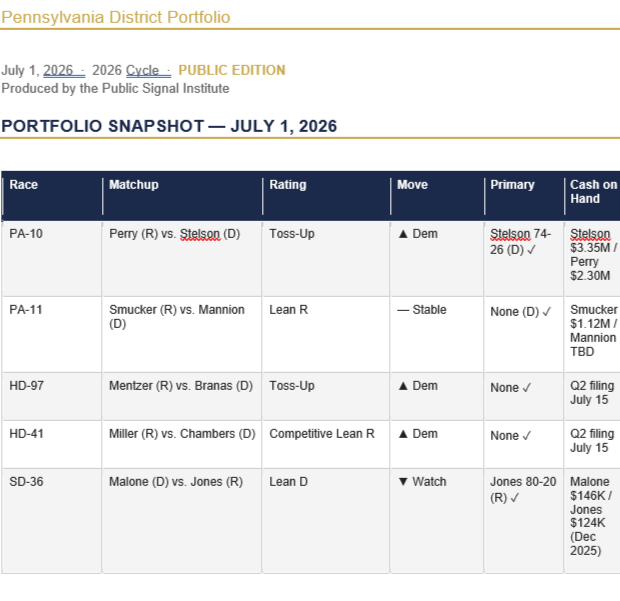
July Analyst Note
The May 19 primary resolved the most important pre-general questions in the portfolio. Janelle Stelson defeated Justin Douglas 74-26 in PA-10 and emerges into the general election with $3,349,267 in cash on hand — more than any Democratic congressional challenger in Pennsylvania and a $1 million advantage over Scott Perry. Tom Jones defeated Jere Swarr 80-20 in the SD-36 Republican primary, unified the Lancaster County Republican party behind him the same night, and advances to face James Malone in the race PSI has been tracking as the most consequential defensive contest in the portfolio.
The environment that produced those primaries has continued to deteriorate for Republicans. Trump's approval in Pennsylvania stands at 29 percent in the June Franklin & Marshall survey — a 10-point drop since March, the sharpest recorded movement in the poll's recent history. His handling of inflation in Pennsylvania registers at 17 percent approval. Forty-seven percent of Pennsylvania voters say they are worse off financially than a year ago. Democrats lead the generic congressional ballot statewide by 12 points, 47 to 35 percent. These are not incremental movements. They are structural deterioration.
Two county Democratic committees turned over their leadership simultaneously — Lancaster County and Dauphin County — within the primary cycle. Both changes were driven by grassroots frustration with top-down management. Both new chairs ran explicitly on doing more organizing work. The transition risk is real. The organizing opportunity is equally real. How Mezzetti in Lancaster County and Dent in Dauphin County execute their first four months will determine whether the leadership change accelerates or disrupts the general election infrastructure.
The National Context
Presidential Approval
Trump's approval in Pennsylvania has fallen to 29 percent in the June 2026 Franklin & Marshall College Poll, conducted June 8-14 among 546 registered Pennsylvania voters. Seventy-one percent rate his performance fair or poor. His approval of handling inflation — the issue that returned him to the White House — stands at 17 percent, down from 31 percent in late 2025. Forty-seven percent of Pennsylvania voters say they are worse off financially than a year ago. Nationally, Civiqs rolling tracking as of June 17, 2026 shows Trump at 37 percent approval and 58 percent disapproval — net negative 21 points. Pennsylvania sits at net negative 15, down from negative 3 at the start of the term.
Affordability
The economic indictment frame PSI has been building for the portfolio now rests on five confirmed data points. PCE inflation reached 3.8 percent annualized in April — the fastest pace since May 2023. Q1 GDP grew only 1.6 percent annualized. Real average hourly earnings fell 0.3 percent from April 2025 to April 2026 — inflation outpacing wages by documented measure. Credit card delinquencies of 90 days or more reached 13.12 percent in Q1 2026, the highest level since the 2008 financial crisis per the New York Fed. University of Michigan consumer sentiment hit its lowest level since 1978 — worse than 2008, worse than COVID, worse than the early 1980s stagflation. In 12 states, 700,000 fewer children are receiving SNAP food assistance under the One Big Beautiful Bill. Pennsylvania families are among those affected.
These five data points connect directly to the voting records of Scott Perry, Lloyd Smucker, Steve Mentzer, and Brett Miller. Perry voted to cut Medicaid for 3 million Pennsylvanians. Smucker helped write the cuts from Ways and Means. Mentzer accepted utility company PAC contributions while families in HD-97 pay elevated rates. Miller's voting record on healthcare access and education funding produced consequences that are now arriving in Lancaster County households. The connection between national economic conditions and specific local votes is the organizing core of every race in this portfolio.
Voter Enthusiasm
Change Research found Democratic vote motivation running 13 points higher than Republican motivation — 88 percent to 75 percent — as of the May survey. Stelson's 74-26 primary win, called before 10 p.m. on primary night, demonstrates organizational capacity. Lancaster County Republican primary turnout reached 25 percent of registered voters — up from 21.2 percent in the 2025 municipal primary but well below the 29 percent turnout in 2024. The enthusiasm asymmetry is measured, not assumed.
Generic Ballot and House Control
Democrats lead the generic congressional ballot by 12 points statewide in Pennsylvania, 47 to 35 percent. Nationally, Democrats are projected with a 78 percent probability of taking the House according to prediction market aggregators. Republicans hold 220 seats. Democrats need a net gain of three. Pennsylvania's four competitive seats could alone deliver the majority.
Supreme Court Decisions — Portfolio Impact
Six Supreme Court decisions issued since April have direct or indirect relevance to the PSI portfolio. Each is assessed by its specific district-level consequence.
Louisiana v. Callais — VRA Section 2 (April 29, 2026)
The 6-3 decision raised the bar for proving illegal racial gerrymandering and has triggered redistricting activity in Alabama, Louisiana, Tennessee, and Florida. In Pennsylvania, election law experts across Spotlight PA, Votebeat, and the Penn Capital-Star assess the direct map impact as limited: Section 2 has rarely been used in Pennsylvania redistricting because most voters of color are already concentrated in cities where their numbers allow them to elect preferred candidates. The Pennsylvania Supreme Court's prohibition on partisan gerrymandering provides a state constitutional backstop that the federal decision does not eliminate. The indirect impact — mobilization of Black and Latino voters who view the decision as a threat — is real and ongoing, and is directly relevant to the BVON-PA organizing strategy PSI has been building through The Franchise and the Callais response framework.
Watson v. RNC — Mail Ballot Postmark (June 29, 2026)
The Supreme Court upheld Mississippi's law allowing election officials to count mail-in ballots postmarked by Election Day that arrive afterward. This is a neutral-to-positive outcome for Democratic turnout operations in Pennsylvania, which already has favorable mail ballot rules. The adverse ruling — forcing states to rewrite mail-voting laws before November — did not occur. Pennsylvania mail ballot operations proceed under existing rules.
Birthright Citizenship — Trump Executive Order Struck Down (June 30, 2026)
The Supreme Court rejected Trump's executive order ending birthright citizenship 6-3, ruling it runs afoul of the 14th Amendment. In Lancaster County's HD-97, where the Latino population has grown significantly across Conestoga, East Lampeter, and West Lampeter townships, this decision creates a dual signal: legal protection affirmed, ICE enforcement threat ongoing. For organizing in communities where immigration anxiety has been a driver of disengagement, the birthright ruling provides a documented legal protection that organizing communications can deploy.
Campaign Finance — Coordinated Spending Limits Struck Down
The Supreme Court struck down limits on coordinated spending between political parties and their candidates. The NRCC and NRSC immediately declared it a decisive victory. This is the decision with the most direct negative impact on the PSI portfolio. The Republican National Committee and Congressional Leadership Fund can now coordinate directly and without financial ceiling with Perry's campaign. Stelson enters the general with a $1 million cash advantage over Perry. That advantage becomes less determinative when unlimited Republican party coordination is layered on top of Perry's campaign committee. The air war arithmetic in the Harrisburg DMA changed on the day this decision was issued. Stelson's fundraising advantage matters more now, not less, because it is the primary hedge against uncapped Republican coordination.
Local Democratic Leadership — Lancaster and Dauphin Counties
Lancaster County Democratic Committee
At the LCDC's quadrennial reorganization meeting on Sunday, June 8, 2026, Michael Mezzetti defeated incumbent Chair Tom O'Brien 194 to 68. Charlotte Brown, chair of the Lancaster Township Area Committee, replaced Vice Chair Stella Sexton. Five former party chairs — Roger Dourte, Bruce Beardsley, Sally Lyall, JoAnn Hentz, and Diane Topakian — endorsed Mezzetti and Brown, citing concerns with O'Brien and Sexton's top-down approach. Mezzetti, who chairs the Hempfield Area Democratic Committee, said he plans a grassroots model allowing each district to operate according to what works for them.
The O'Brien tenure produced documented results: the committee tripled its number of active committee members, rebuilt its donor base from near-bankruptcy, and ran a clean unanimous endorsement convention on February 25, 2026 — endorsing Mannion, Chambers, Branas, and Malone without a single dissenting vote. Former State Rep. Mike Sturla stated the party had never been in better position during his tenure in Lancaster politics. The critique that produced the change was not about results. It was about process — specifically, the complaint that top-down management discouraged local initiative and district-level adaptation.
Malone endorsed the losing slate. O'Brien and Sexton's reelection campaign website listed Malone among its endorsers alongside state Reps. Nikki Rivera and Izzy Smith-Wade-El. Malone backed the candidate who lost by a margin of 194 to 68. The new LCDC chair and the SD-36 incumbent senator now begin the general election campaign having backed opposing sides in an internal party election decided six weeks before the general election campaign begins in earnest. Whether Mezzetti and Malone can build a functional working relationship quickly enough to coordinate SD-36 infrastructure through the new grassroots model is the first organizing test of the new leadership.
The transition risk: O'Brien built the donor infrastructure, the committee member relationships, and the operational systems over four years. Those assets do not transfer automatically. Mezzetti inherits them with four months to prove the grassroots model works at scale in a general election cycle — and to do so while managing a relationship with an incumbent senator who backed the other side.
Dauphin County Democratic Committee
In Dauphin County, Steelton Mayor Ciera Dent replaced 12-year chair Rogette Harris, receiving 88 of 136 votes cast by the committee. Harris became the first African-American elected chair of the county Democrats and held the position since 2014. She failed in her bid to keep her seat on the committee in the May primary election, which effectively signaled the outcome before the reorganization vote.
Dent's statement — 'we as a county, we as a committee should be doing more work' — is an organizing mandate. Her base as Steelton Mayor sits inside the PA-10 district. Steelton is a majority-Black community within Dauphin County, and Dent's existing networks in the borough are directly relevant to the turnout operation Stelson needs to close the gap against Perry. The Dauphin County Committee is the organizational floor of PA-10's Democratic infrastructure.
The same transition risk applies in Dauphin as in Lancaster. Harris built 12 years of donor relationships, committee member networks, and operational systems. Dent inherits them with four months to execute the most important Democratic general election in Dauphin County since 2018. Her advantage is that Democratic voter enthusiasm is running 13 points higher than Republican enthusiasm, Stelson has $3.35 million in cash, and Perry handed the general election's first news cycle to Democrats the night of the primary with a statement that will appear in Stelson's advertising.
The opportunity: A new chair who explicitly ran on doing more work, in a cycle with the most favorable Democratic environment in eight years, with a candidate who just won 74-26 and holds the largest Democratic challenger cash position in PA-10's competitive history. The question is execution, not environment.
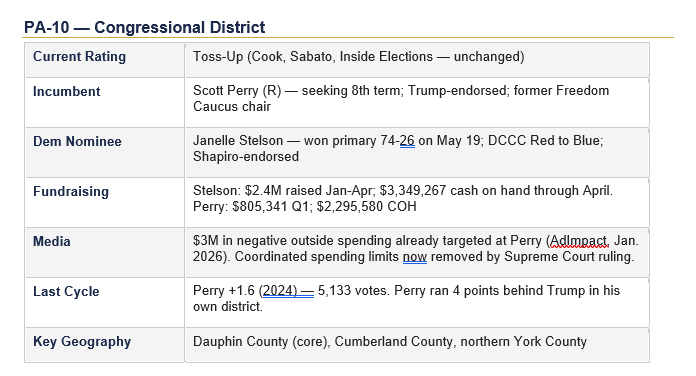
State of the Race
Stelson emerges from the primary in the strongest position a Democratic challenger has ever held in this district entering a general election. She holds a $1 million cash advantage over Perry, carries DCCC Red to Blue support and Shapiro's endorsement, and won her primary by a margin — 74-26 — that signals organizational capacity rather than a fractured coalition.
Perry's post-primary statement is the first general election news cycle and it went to Stelson without her spending a dollar. His declaration that she is the 'same carpetbagging, racist, tax hiker we defeated less than two years ago' is a base mobilization signal, not a persuasion argument. Perry has won this seat six times. He knows his electorate. His calculation is that his base is sufficient and that the turnout model he needs is achievable. That calculation deserves respect, not dismissal. He ran four points ahead of Trump in 2024 and won. Trump is now 29 percent in Pennsylvania. The question is whether Perry's base has held while everything around it has collapsed.
The Supreme Court's removal of coordinated spending limits is the most significant new structural variable in this race. Perry's campaign, the RNC, and the CLF can now coordinate without financial ceiling. The $4 million Republicans spent defending Perry in 2024 against $7 million in Democratic spending produced a win. Uncapped coordination in 2026 means the Republican spending floor is meaningfully higher than 2024. Stelson's cash advantage is the primary Democratic hedge, and it is real — but it is no longer a guaranteed structural advantage in the air war.
Paid and Earned Media
Perry has been targeted with $3 million in negative outside spending as of January 2026 — before Stelson had even won the primary. Outside groups identified PA-10 as a priority takedown before the general election campaign began. The Harrisburg DMA general election air war opens in August. The coordinated spending decision means Republican coordination can operate without the prior legal ceiling. First to air in the Harrisburg DMA often sets the frame that holds through November. Watch for ad reservation filings through July and August.
Perry's 'carpetbagging, racist, tax hiker' statement has already generated earned media across Pennsylvania outlets and national political press. Stelson's response — 'The story of Congressman Scott Perry just keeps getting worse' — is clean, on-message, and does not engage the personal attack. That is the correct call. The response keeps the frame on Perry's record rather than the attack, which is precisely where Stelson wins and Perry loses.
Dauphin County Committee — Impact on PA-10
Ciera Dent's election as Dauphin County Democratic Committee chair is a direct organizational variable for PA-10. Dauphin County is the core of the district. Dent's base in Steelton — a majority-Black community inside the district — is relevant to the turnout operation Stelson needs to perform against Perry. A 12-year chairmanship transitioned in the middle of a general election cycle. The institutional knowledge transfer and donor relationship continuity are the variables to watch. Democratic enthusiasm at 13 points above Republican motivation is the environmental floor Dent inherits.
Watch List — July
• Douglas endorsement: Douglas explicitly withheld endorsement commitment before the primary, stating publicly at an April 27 candidate forum that Stelson would have to earn his endorsement and that it would not come automatically. ABC27 confirmed on primary night that Douglas did not commit to supporting Stelson after losing. No endorsement has been reported as of July 1. The CASA In Action, One Pennsylvania, and APIA PA coalitions Douglas brought into the primary are not automatically transferred to Stelson. Activating those networks for the general election requires outreach from the Stelson campaign, not an assumption of loyalty.
• Ad reservation filings — Harrisburg DMA: First general election broadcast reservations expected in July and August. Watch for DCCC and CLF reservation filings as the air war baseline.
• Dent-Stelson coordination: First joint public activity between Dent's committee and the Stelson campaign signals whether the leadership transition has been absorbed into general election operations.
• Q2 FEC filing July 15: Stelson's Q2 number is the first indicator of whether she can sustain the cash advantage through the fall. Perry's Q2 number, plus CLF coordination, reveals the total Republican spending environment.
The accountability frame: Scott Perry voted to cut Medicaid for 3 million Pennsylvanians. He voted to strip food assistance from 144,000 families in his own state. He was the deciding vote. He called his opponent a racist. Everything else is detail.
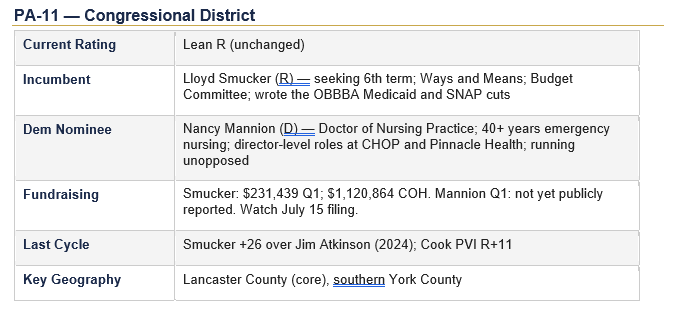
State of the Race
PA-11 is a long-game accountability race. Smucker won by 26 points in 2024 in a Cook PVI R+11 district. That margin does not close in a single cycle regardless of the national environment. The race in 2026 is about building the public record that makes 2028 or 2030 a different conversation.
Smucker's record on Ways and Means is the accountability core. He helped write the Medicaid and SNAP cuts. He voted against certifying Pennsylvania's electoral votes on January 6. He voted against Medicare drug price negotiation in a district where seniors turn out at 68 percent. His $5,000 donation to Tom Jones in SD-36 connects Smucker's congressional operation directly to the most competitive state senate race in Lancaster County — a fact that Malone's campaign can use to tie the Republican candidates together.
Nancy Mannion's background as a registered nurse with a Doctor of Nursing Practice and director-level emergency experience at Children's Hospital of Philadelphia and Pinnacle Health gives her clinical authority on Smucker's Medicaid votes that no political framing can replicate. When a nurse with 40 years of emergency experience explains what Medicaid cuts mean for Lancaster County families, it is a different kind of argument than a campaign advertisement.
LCDC Leadership — Impact on PA-11
Mannion's campaign is the top-of-ticket Democratic presence in Lancaster County. The LCDC leadership change directly affects the organizational infrastructure her campaign depends on for voter contact and turnout. Michael Mezzetti's grassroots model, with district-level autonomy, could accelerate cross-race coordination — or fragment it. The February 25 unanimous endorsement convention that produced clean slates for Mannion, Branas, Chambers, and Malone was an O'Brien operation. Replicating that coordination level under a new model in a compressed general election timeline is the practical challenge.
Watch List — July
• Mannion Q1 FEC filing: The first fundraising benchmark reveals the baseline gap with Smucker and determines the advertising window the campaign can operate in.
• Smucker constituent access: Documentation of public availability and town hall frequency is a legitimate earned media angle in a district where he won by 26 points and may be governing as if accountability is impossible.
• Cross-race coordination: Mannion, Branas, and Chambers operating joint voter contact before July is the most consequential organizing decision in the Lancaster portfolio.
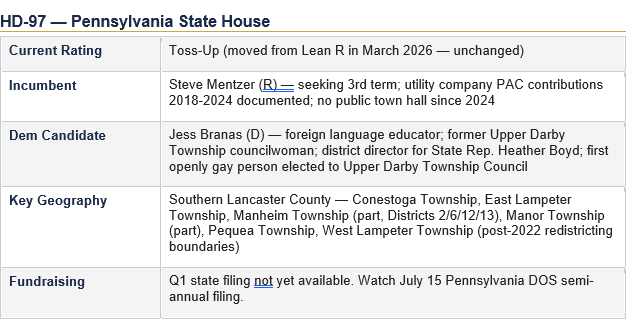
State of the Race
HD-97 holds at Toss-Up. Two issues that drove that rating shift in March are both more active entering July than they were in March. Utility rate pressures in Lancaster County have intensified — families in Conestoga, East Lampeter, and West Lampeter townships are carrying elevated energy costs as a documented household budget item. Mentzer has been publicly silent. Branas has engaged the issue directly and has a documented record of constituent engagement from her Upper Darby Township Council experience that she can contrast against Mentzer's unavailability.
Mentzer's Tier 1 vulnerability profile is established and deployable: utility company PAC contributions from 2018 to 2024 confirmed in FEC and PECF records, vote against utility affordability measures in the House Consumer Affairs Committee on record, no documented public town hall since 2024. His connection to the Perry-Smucker federal Republican network ties him to a brand that now registers 29 percent approval in Pennsylvania. His support for school voucher policies that redirect public school funding is directly relevant to Branas's background as a public school educator.
Branas's biography is the structural asset for this district. A public school foreign language educator running against a candidate who voted to divert public school funding to private institutions is not an abstract contrast. It is a personal one. Her experience as the first openly gay person elected to Upper Darby Township Council demonstrates she can build crossover coalitions — the same kind of coalition HD-97 requires.
LCDC Leadership — Impact on HD-97
HD-97 sits within the LCDC's organizing territory. Mezzetti's grassroots model specifically addresses the concern that O'Brien's top-down approach discouraged district-level initiative. For HD-97, which requires a crossover organizing strategy tailored to southern Lancaster County's specific demographic composition, district-level autonomy could be an asset. The risk is that the model has not been tested at general election scale. Watch whether the HD-97 district committee activates under the new framework or waits for central guidance that may be slower to arrive under a decentralized model.
Watch List — July
• Branas fundraising — July 15 PA DOS filing: First financial benchmark. The gap with Mentzer determines the advertising window.
• PUC utility rate action: Any Pennsylvania Public Utility Commission action on rate increases in the Lancaster area is a ready-made closing argument. Mentzer's silence becomes the story.
• Mentzer public calendar: If he begins scheduling visible public events in June or July, he is signaling internal polling concern. His pattern since 2024 has been to avoid constituent-facing accountability situations.
State of the Race
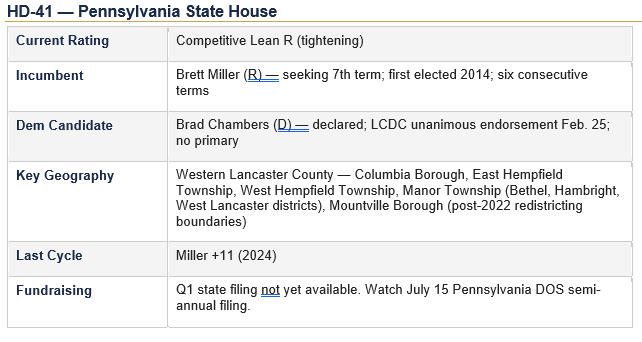
Brett Miller has held HD-41 since 2014 — six consecutive terms. His 2024 margin was approximately 11 points. He holds the district on name recognition and incumbent advantage, not policy positioning. His voting record on education funding, reproductive rights, and healthcare access is the accountability core. The message discipline required is identical to every other race in this portfolio: named votes, specific consequences, no fog.
Chambers enters the general with a clean launch: unanimous LCDC endorsement in February, no primary challenge, and a campaign that has been organizing since the endorsement while Miller operates on the assumption of structural safety. The 2026 environment is the most favorable a Democratic challenger has faced in HD-41 since Miller first won the seat. The SD-36 special election result in March 2025 demonstrated that organized, candidate-centered Democratic campaigns can be competitive in Lancaster County legislative districts that have not been seriously contested in years.
LCDC Leadership — Impact on HD-41
Mezzetti chairs the Hempfield Area Democratic Committee — which sits within HD-41's boundaries. East Hempfield and West Hempfield townships are the geographic core of HD-41. Mezzetti is not just the new LCDC chair. He is the district chair for the territory where Chambers is running. That is a meaningful organizational alignment. The risk is the same as the portfolio-wide risk: transition disruption during a compressed general election window. The opportunity is that Mezzetti has direct existing relationships in exactly the precincts Chambers needs to perform in.
Watch List — July
• Chambers fundraising — July 15 PA DOS filing: First financial benchmark.
• Mezzetti-Chambers coordination: The LCDC chair's home district is the HD-41 battleground. Whether that proximity accelerates organizing or creates confusion about roles is the first practical test of the new leadership model.
• Miller public events: Any visible town halls or community events in June or July signal internal polling concern. His public calendar since 2024 has been largely inactive.
State of the Race
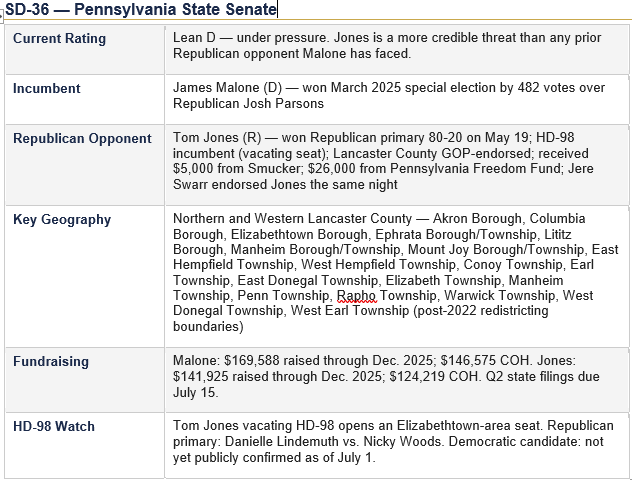
The SD-36 rating holds at Lean D but the threat profile has changed materially since the May primary. Jones won 80-20 with all 120 precincts reporting. Swarr called Jones the same night and offered full support. Jones's statement — 'today's primary results were a victory for our united Republican Party across Lancaster County' — reflects an institutional consensus that was not present in the March 2025 special election, when the Republican candidate was Josh Parsons and the county party had not fully consolidated around a single contender.
Jones enters the general with specific structural advantages Malone has not previously faced. He served on the Housing and Community Development, Agriculture and Rural Affairs, and Local Government committees in the state House — committees with direct relevance to the rural and agricultural townships that form SD-36's Republican base in Conoy, Earl, Rapho, and Warwick. His $5,000 contribution from Smucker connects him to the most powerful Republican in Lancaster County's congressional representation. His $26,000 from the Pennsylvania Freedom Fund signals Freedom Caucus network support. He also brings a voter file from his HD-98 campaigns that covers portions of the SD-36 geography — an organizing head start that the special election Republican candidate did not have.
Malone's advantages are real and should not be understated. He has governed with visible local presence since March 2025 — constituent services, community events, and legislative work on utility costs and small business access. Incumbency is being built deliberately. The SD-36 townships of Lititz, Manheim Township, and East and West Hempfield have been trending more Democratic in recent cycles, according to the Lancaster Independence primary night coverage. Those demographic trends are structural. Jones cannot reverse them by winning the primary. He can organize against them.
Malone's Endorsement of O'Brien — The LCDC Variable
Malone endorsed the losing slate in the LCDC reorganization election. Tom O'Brien and Stella Sexton listed Malone as a supporter on their reelection website. The new chair — Michael Mezzetti — defeated the slate Malone backed 194 to 68. Four months before the general election, the SD-36 incumbent and the Lancaster County Democratic Committee chair begin their working relationship having backed opposing sides in a contested internal party election. That is not a fatal condition. It is a real one. Whether Mezzetti's grassroots model can provide Malone's general election campaign with the precinct-level organizing infrastructure it needs — and whether Malone can build a functional working relationship with the committee that rejected his preferred leadership — is the most important organizational question in the Lancaster County portfolio.
HD-98: Secondary Watch Item
Jones's departure from HD-98 to run for SD-36 opens an Elizabethtown-area state house seat. The Republican primary produced a contest between Elizabethtown School Board Member Danielle Lindemuth and Lancaster County Clerk of Courts Nicky Woods. No Democratic candidate for HD-98 has been publicly confirmed as of July 1. PSI flagged HD-98 as a watch item in May pending the primary result. The watch item remains active. An open seat in a cycle with a Democratic +12 generic ballot environment is an opportunity that requires a candidate to convert. The window for candidate recruitment has not closed but it is not unlimited.
LCDC Leadership — Impact on SD-36
The SD-36 organizational infrastructure is the most directly affected by the LCDC leadership change of any race in the portfolio. The networks built to win the March 2025 special election — BVON's organizing anchor and Lancaster Stands Up's ward-level capacity — remain active. Under the new grassroots model, those networks operate with district-level autonomy rather than central committee direction. That model could be advantageous if the SD-36 district-level organizing capacity is strong enough to function independently. The outstanding question is whether the transition from O'Brien's coordinated model to Mezzetti's distributed model will produce continuity or disruption in the four months between now and November 3.
Watch List — July
• Jones fundraising — July 15 PA DOS filing: First Q2 look at Jones's general election financial position. Watch for Freedom Caucus network contributions and whether Smucker increases his investment.
• Malone-Mezzetti working relationship: First public joint activity between the SD-36 campaign and the new LCDC chair signals whether the internal endorsement split has been managed.
• HD-98 candidate recruitment: Democratic candidate filing for HD-98 must happen before the general election deadline. PSI is monitoring. No confirmed candidate as of July 1.
• Jones legislative record: His committee work on Housing and Community Development and Agriculture gives him substantive Lancaster County credentials. Watch whether he pivots from his primary message of spending cuts and life issues to a general election message on local economic concerns.
• Swarr unity: Swarr's same-night endorsement of Jones and stated commitment to doing 'whatever it takes' to ensure a Jones victory signals a unified Republican field operation. Watch whether Swarr's rural Rapho Township network activates for Jones.
Analyst Notes — July 2026
Cross-Portfolio Observations
All five PSI portfolio races now have confirmed general election matchups. No Democratic primary produced coalition damage. No Republican primary produced a divided field in a competitive race. The general election environment — Trump at 29 percent in Pennsylvania, Democratic enthusiasm 13 points above Republican enthusiasm, generic ballot Democrats +12 — is the most favorable Democrats have faced in this state in eight years. The question that has been the same since PSI's first HorseRace in April remains the same: whether the campaigns are organized enough to convert the environment.
The LCDC and Dauphin County leadership changes are the most significant new organizational variable entering the general election. Both transitions were necessary by the judgment of the committees that made them. Both carry real transition risk in a compressed timeline. The new chairs — Mezzetti and Dent — ran on doing more work. The general election is the immediate test of whether that commitment produces results at the scale required.
What Moves the Map — July Update
Shapiro's margin remains the structural floor. His approval stands at 60 percent in Pennsylvania, with 35 percent approval even among Pennsylvania Trump voters in 2024. Every Democratic candidate in this portfolio benefits from the Shapiro coattail.
The coordinated spending Supreme Court ruling is the new variable that most changes the portfolio's financial calculus. Stelson's cash advantage is real but now operates in a legal environment where Republican party coordination with Perry is uncapped. The August air war will reveal whether the structural financial advantage held.
Implementation continues to drive the economic accountability frame. Medicaid work requirements hit December 31 — after the election — but the anxiety and paperwork burden are present in households now. Every family that receives a coverage change letter has a concrete reason to connect it to a specific vote by a specific candidate on a specific ballot. The candidates who build that connection explicitly, repeatedly, and with named actors will carry an advantage the opposition cannot neutralize with advertising alone.
The environment is set. The committees have new leadership. The candidates are confirmed. One hundred and fifty-four days to November 3.
PUBLIC SIGNAL INSTITUTE · HORSERACE REPORT · JULY 1, 2026
Produced by the Public Signal Institute. All race assessments reflect publicly available information as of July 1, 2026. All district boundaries reflect post-2022 Pennsylvania redistricting maps certified by the Pennsylvania Supreme Court.