
AUGUST 2026 HORSERACE REPORT
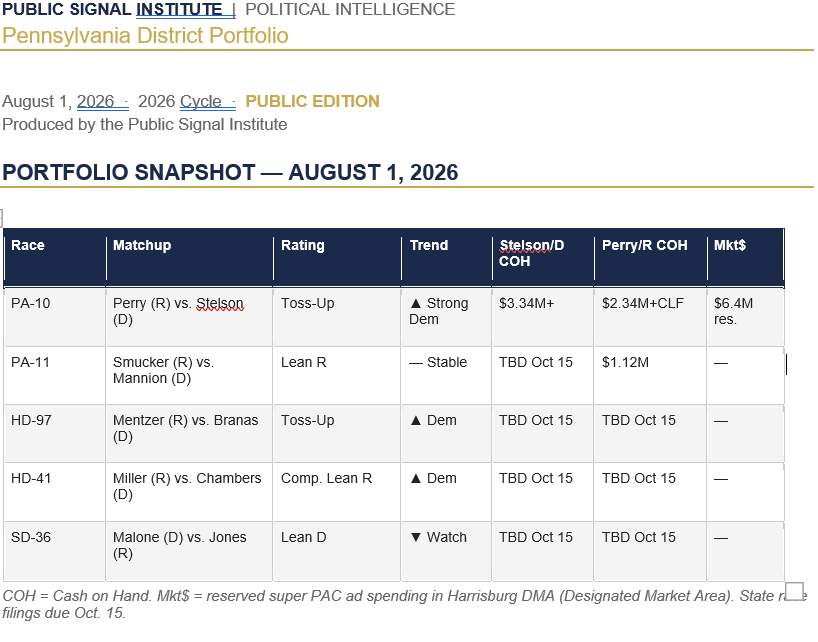
August Analyst Note
Ninety-three days from November 3, the environment has moved further and faster than any prior PSI projection anticipated. Donald Trump's net approval rating hit a new second-term low of -20.6 on July 30, according to Silver Bulletin's weighted polling aggregate — lower than at any point in his first term, including the period following January 6, 2021, when it bottomed at -19. CNN's July 29 survey put his overall approval at 34 percent, matching his career low. Within his own party, enthusiasm for the rest of his second term stands at 19 percent, down from 38 percent last spring.
That environment has produced the most expensive congressional race in Pennsylvania history. PA-10 has seen $11.5 million raised between Stelson and Perry, with $6.4 million in super PAC ad reservations already placed in the Harrisburg DMA — $3.5 million from the House Majority PAC for Democrats and $2.9 million from the Congressional Leadership Fund for Republicans. The air war is not coming. It is here. Fifty percent of a cycle's political dollars run in the 30 days before Election Day. The Harrisburg DMA is entering the most saturated political advertising environment it has ever experienced.
The national forecasters have responded to the environment. Decision Desk HQ projects a 225-210 Democratic House majority as of late July. Prediction markets now give Democrats an 83 percent chance of flipping the House. In PA-10 specifically, Stelson holds a 76 percent probability on Kalshi against Perry's 18 percent. Sabato's Crystal Ball moved PA-8 from Lean R to Toss-Up on July 30 — a signal that the competitive map in Pennsylvania is expanding, not contracting.
The qualification that every responsible analyst is attaching to these numbers is this: DDHQ (Decision Desk HQ)'s chief analyst Geoffrey Skelley called it 'far from a blue wave kind of environment.' The generic ballot, while strongly favorable to Democrats at D+6.3, has narrowed by about one point since May. History shows presidential approval does not move much between July and November. The environment is set. The races are set. The question, as it has been since April, is execution.
Presidential Approval — The Defining Variable
The Numbers
The polling consensus entering August 2026 is the most unfavorable for a sitting president since Harry Truman in 1952. The range across major pollsters as of July 30: CNN 34 percent, WaPo/Ipsos 37 percent, Quinnipiac 38 percent, Economist/YouGov 40 percent, RealClearPolitics average 41.1 percent, Ballotpedia 40 percent. Silver Bulletin's weighted aggregate — which adjusts for house effects and recency — shows Trump at a net approval of -20.6, a new second-term low set July 30.
The internal composition of that approval tells the more important story. Among voters aged 18 to 34, 70 percent disapprove. Among Republicans, only 78 percent approve — a new low within his own party, down from the low 90s at the start of his second term. Only 19 percent of Republicans say they are enthusiastic about the rest of his second term, down from 38 percent last spring. The president is underwater not just with the general electorate but with the base he needs to turn out in November.
The Attention Economy Dimension
CNN's July 29 poll found that 65 percent of Americans say Trump does not put the good of the country ahead of his personal gain. Only 27 percent say he is in touch with the problems of ordinary Americans. The ICE shooting deaths produced a 20-point margin saying the agency is making cities less safe, not more. Following the cyclospora outbreak and a measles surge, 34 points more Americans say changes to FDA (Food and Drug Administration) and CDC (Centers for Disease Control and Prevention) have left the public less safe, not more.
These are not polling artifacts. They are attention economy events — specific incidents with specific imagery that land in the information environment and change the frame. The war in Iran, rising gas prices, and the cost-of-living collapse are the three largest attention drivers pulling approval down. Senator Thom Tillis said in late July that the Iran war 'is becoming an additional political drag.' Scott Perry voted for the budgets that funded that war posture and has been publicly silent on its human cost. That silence is a vulnerability. Reuters/Ipsos (July 24–26, 2026) confirmed the Iran drag through a second independent methodology: only one-third of voters support the war, and 69 percent say Trump has not clearly explained its objectives. Among independents specifically, the Reuters/Ipsos survey found Democratic congressional candidates favored over Republicans 36 to 20 percent — a 16-point independent preference confirmed by a second major pollster in the same week as Quinnipiac.
The Enthusiasm Gap — Quantified
Americans for Prosperity Action (AFP Action), the Koch-network conservative super PAC, published findings from its door-knocking and polling operation covering Iowa, Ohio, North Carolina, Montana, New Hampshire, and Michigan: approximately one in five reliable Republican base voters — people who have voted in every primary and general election for eight years — are either planning to stay home in November or considering voting for Democrats. AFP Action executive director Nathan Nascimento called it 'a scary number.' Republican pollster Mitchell Brown at Cygnal found Democratic enthusiasm matching 2018 levels while Republican enthusiasm runs 'far below' that benchmark. In 2018, Democrats gained 41 House seats.
The Washington Post/Ipsos poll quantified the practical consequence: Democrats hold a 10-point advantage among voters who say they are absolutely certain to vote in November. The overall generic ballot shows Democrats leading by 6.3 points per Silver Bulletin. The gap between the topline and the certain-voter number is where elections are decided.
The 2018 comparison: Mitchell Brown at Cygnal: Democratic enthusiasm now matches 2018. Republican enthusiasm is far below 2018. In 2018, Democrats gained 41 House seats. Democrats need 5 net gains to flip the House in 2026.
National Context — House, Senate, Pennsylvania
House Control
Republicans currently hold 220 seats. Democrats need 5 net gains for the majority. Decision Desk HQ's late July model projects a 225-210 Democratic advantage. As of the most recent median rating between Cook, Inside Elections, and Sabato's Crystal Ball: Democrats are favored in 205 districts, Republicans in 211, with 19 Toss-Ups. Democrats need to win every seat where they are currently favored plus 13 more — the clearest route runs through the Toss-Ups, 15 of which are Republican-held. Prediction markets give Democrats an 83 percent probability of flipping the House. PA-10 is one of the 15 Republican-held Toss-Ups.
Sabato's Crystal Ball moved three Senate ratings toward Democrats on July 30: North Carolina to Leans Democratic, Alaska and Ohio to Toss-Ups. Seven House incumbents have already been denied renomination — above the postwar average of 6.5. The competitive map is expanding into territory Republicans expected to hold.
Pennsylvania Specifically
Pennsylvania's four competitive congressional seats — PA-1, PA-7, PA-8, and PA-10 — remain the single highest concentration of competitive Republican-held districts in any state. PA-8 moved from Lean R to Toss-Up on July 30. PA-10 holds at Toss-Up with Stelson at 76 percent in prediction markets. Every credible House path for Democrats runs through Pennsylvania.
Governor Shapiro's reelection campaign has integrated directly with the congressional pickup effort. Political scientists at Temple and Lehigh universities both noted in July reporting that Shapiro's 2022 victory in Perry's district — combined with his 60 percent approval rating — makes him the most important structural variable for downballot Democratic performance in the state. In 2022, Shapiro won with 50 percent turnout. Robin Kolodny at Temple: 'The last time Trump was in office and he had a midterm election in 2018, this state had unprecedented voter turnout, 50 percent. Normally it's close to 40 percent. If that happens again, then every Republican incumbent is vulnerable.'
Paid Media — The Air War Is Open
The Harrisburg DMA
House Majority PAC (HMP) has reserved $3.5 million in the Harrisburg DMA. Congressional Leadership Fund (CLF) has reserved $2.9 million. Total reserved super PAC spending in the Harrisburg market alone is $6.4 million — before either candidate committee has begun broadcast advertising in earnest. Across all Pennsylvania media markets, total super PAC reservations stand at $33.5 million: $20 million from HMP for Democrats and $13.5 million from CLF for Republicans.
The 2026 national cycle is projected to reach $11.6 billion in total political advertising — a record, exceeding both the 2022 midterm ($8.9 billion) and the 2024 presidential cycle. AdImpact projects broadcast at $5.6 billion, CTV (Connected Television) at $2.6 billion, cable at $1.4 billion, and digital at $1.68 billion. Historical data shows 50 percent of a cycle's political dollars run in the 30 days before Election Day. For PA-10, that means the Harrisburg DMA is entering a period of historic advertising saturation between Labor Day and November 3.
PA-10 Fundraising — The Race
Stelson has raised more than $6.3 million since launching her campaign, including $1.5 million in the weeks leading up to and following her primary win, according to her July FEC (Federal Election Commission) filing. Perry has raised $4.47 million across the full cycle. As of April 30 — the most recent detailed figure — Stelson held $3.34 million cash on hand (COH) against Perry's $2.34 million. Perry spent just under $275,000 from April 30 to the end of June; Stelson spent just under $545,000 — nearly twice Perry's rate. PA-10 is now the most expensive congressional race in Pennsylvania, with over $11.5 million raised between the two candidates combined.
The Supreme Court's removal of coordinated spending limits changed the air war arithmetic. CLF's $2.9 million reservation in the Harrisburg DMA (Designated Market Area) can now be coordinated directly and without ceiling with Perry's campaign. The effective Republican resource base in this race — Perry's campaign plus CLF coordination — exceeds $5.2 million before Perry's general election fundraising is counted. Stelson's cash advantage is real and significant. It is not a structural guarantee in a market where uncapped coordination is now legal.
Lehigh University political scientist Chris Borick: approximately 5 percent of voters in PA-10 are still making up their minds. Both campaigns are directing resources toward turnout and persuasion in what amounts to a very small universe of movable voters in a very expensive media environment.
Earned Media — Perry's Primary Night Statement
Scott Perry's primary night statement calling Stelson 'the same carpetbagging, racist, tax hiker we defeated less than two years ago' produced the first general election earned media cycle — and it went entirely to Stelson. The statement generated immediate coverage across Pennsylvania outlets and national political press. Stelson's response — 'The story of Congressman Scott Perry just keeps getting worse' — returned to Perry's record rather than engaging the attack. That is the correct call. Perry's statement functions as a base mobilization signal in a cycle where Republican base motivation is the party's central problem. Whether it activates his base or alienates the moderate Republicans Stelson needs to win is the open analytical question.
The MAGA Media Collapse — A Structural Variable
The machine that turned out MAGA (Make America Great Again) voters in 2024 is running at half speed — and breaking down in public. A New York Times analysis published July 31, 2026 documented audience collapse across the leading right-wing content ecosystem. Of the dozen leading MAGA content creators analyzed, only a few saw their audiences grow since Trump’s re-election. Dan Bongino’s livestream audience has shrunk by roughly half from its 2024 peak. Benny Johnson has lost millions of weekly YouTube views. Candace Owens dropped from 16 million weekly views to 4.1 million — a 65.6 percent loss. Megyn Kelly has lost 65.7 percent of her weekly viewing audience since January 2025. Ben Shapiro’s Daily Wire has seen its YouTube audience fall by nearly 90 percent from its 2023 peak, with the organization laying off a significant portion of its workforce.
The fragmentation is not uniform. Creators who have broken with Trump — on Iran, on the economy, on the cost of living — are showing audience gains. Nick Fuentes and Candace Owens, after periods of declining viewership, saw their audiences grow more recently as they began criticizing Trump. The Times concluded these figures will “play a larger role in the future of right-wing content online.” That audience is being held in conspiracy and grievance content that does not reliably convert to Republican candidate votes.
For competitive Pennsylvania districts where MAGA content amplification has historically driven turnout — PA-10 and PA-11 in particular — this represents a structural change in the Republican mobilization environment that polling alone does not capture. Scott Perry’s coalition in 2024 was built in part on a right-wing media ecosystem that delivered consistent pro-Trump messaging to low-information Republican voters in Dauphin, Cumberland, and York counties. That ecosystem is operating at a fraction of its 2024 capacity. The voters it was keeping engaged are now either disengaged or being pulled toward content that criticizes the president those candidates are running alongside. This is not a reason to project a Perry loss. It is a reason to understand that the Republican mobilization floor in PA-10 is lower in 2026 than any prior cycle’s polling model anticipated.
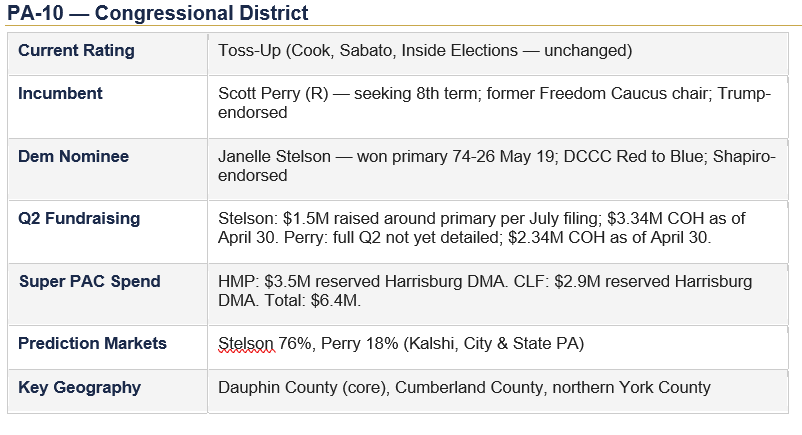
State of the Race
PA-10 is now the most expensive congressional race in Pennsylvania. Stelson enters the fall air war with a fundraising and cash-on-hand advantage over Perry, DCCC (Democratic Congressional Campaign Committee) Red to Blue support, Shapiro's endorsement, and a primary result — 74-26 — that demonstrates organizational capacity. Prediction markets have moved decisively to Stelson at 76 percent. The Cook Political Report and both parties describe Perry as one of the most vulnerable House Republicans in the country.
Perry is not a weak incumbent. He has won this district seven times. His campaign raised nearly $900,000 in Q2 2024 — a comparable period — and his political network is intact. The CLF reservation in the Harrisburg DMA plus uncapped RNC (Republican National Committee) coordination means the Republican resource base surrounding Perry's campaign is substantial. The 5,133-vote margin in 2024 tells you the district is competitive. It does not tell you Stelson wins.
The Douglas coalition remains the open variable. Justin Douglas refused to commit to endorsing Stelson before the primary, conditioning any support on changes to her immigration positions. As of August 1, no full public endorsement has been confirmed. The CASA In Action, One Pennsylvania, and Asian Pacific Islander Political Alliance networks Douglas activated in the primary are not automatically transferred to Stelson's general election coalition. Activating them requires direct outreach from the campaign — and the Dauphin County committee transition under Ciera Dent, while promising, is still in its early operational phase.
Watch List — August
• Perry Q2 full filing detail: The precise cash-on-hand figure entering the fall tells us the real gap between the two campaign committees heading into the air war.
• Douglas public endorsement: Still unconfirmed as of August 1. Every week without it is a week the immigration-focused coalition Douglas built is not actively working for Stelson.
• CLF first ad buy: When CLF places its first broadcast ad in the Harrisburg DMA, the frame it establishes — Perry's record or Stelson's character — will define the opening weeks of the general election campaign.
• Trump endorsement liability: Quinnipiac’s July 29 poll found 48 percent of registered voters say a Trump endorsement makes them less likely to vote for a House candidate, versus 17 percent more likely — a 31-point net negative nationally and a 41-point net negative among independents. Perry’s entire general election brand is built on that endorsement. Among the 5 percent of PA-10 voters still making up their minds, the endorsement liability is the most actionable data point for Stelson’s persuasion operation.
• Shapiro joint events: Shapiro integrating his reelection with congressional pickup races is the turnout multiplier. Watch his public schedule in the PA-10 district.
The accountability frame: Scott Perry voted to cut Medicaid for 3 million Pennsylvanians. He voted to strip food assistance from 144,000 families in his own state. He called his opponent a racist on primary night. That is the sentence. Everything else is detail.
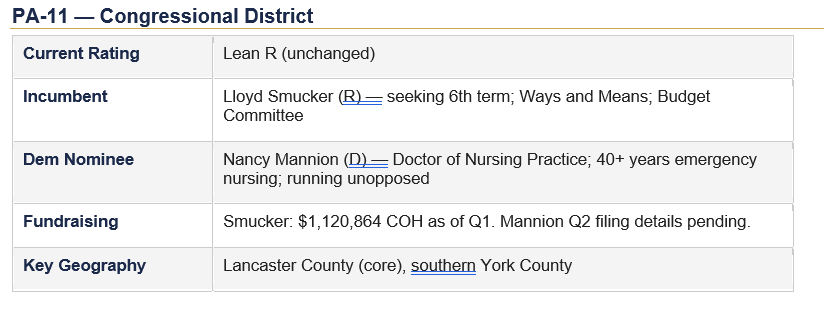
State of the Race
PA-11 remains a long-game accountability investment. Smucker won by 26 points in 2024 in a Cook PVI (Partisan Voter Index) R+11 district. The structural math does not change in one cycle. The value of this race in 2026 is the public record Nancy Mannion is generating against Smucker's Ways and Means votes — every cut to Medicaid and SNAP (Supplemental Nutrition Assistance Program), every drug pricing vote, every January 6 position — that 2028 or 2030 candidates will use. Mannion's clinical authority as a nurse with 40 years of emergency experience is the accountability frame Smucker cannot neutralize with advertising.
Watch List — August
• Mannion Q2 fundraising: First real indicator of her financial viability for a fall campaign. Smucker's $1.1M COH is the gap to watch.
• Smucker's Medicaid messaging: As implementation of OBBBA (One Big Beautiful Bill Act) provisions continues, Smucker must defend his Ways and Means role in writing the cuts. Watch for any public statement that can be deployed as accountability content.
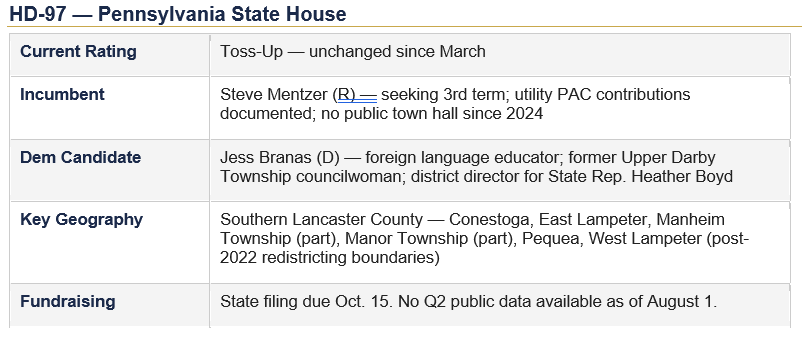
State of the Race
HD-97 holds at Toss-Up. The two dynamics that drove the rating change in March — utility rate pressures and ICE (Immigration and Customs Enforcement) enforcement activity across southern Lancaster County — are both more acute in August than they were then. Mentzer's documented silence on utility costs and his Tier 1 vulnerability profile — utility PAC (Political Action Committee) contributions from 2018 to 2024 confirmed, no public town hall since 2024 — are the accountability frame. Branas's background as a public school educator running against a candidate who voted for school voucher policies is the structural contrast.
The enthusiasm environment is the asset. In a cycle where Democratic base motivation runs 13 points above Republican motivation, and AFP Action's own data shows 1 in 5 reliable Republican base voters at risk in exactly the types of rural and suburban districts that overlap with HD-97's geography, the turnout model has moved toward Branas without a single campaign event being held.
Watch List — August
• Mentzer public events: Any scheduled public appearances in August signal internal polling concern. His pattern since 2024 has been consistent absence.
• LCDC field activation: Michael Mezzetti's first significant cross-race voter contact effort under the new grassroots model will tell us whether the LCDC transition is producing results or disruption.
• State fundraising — Oct. 15: The first complete picture of the HD-97 financial environment. Gap with Mentzer determines the advertising window.
State of the Race
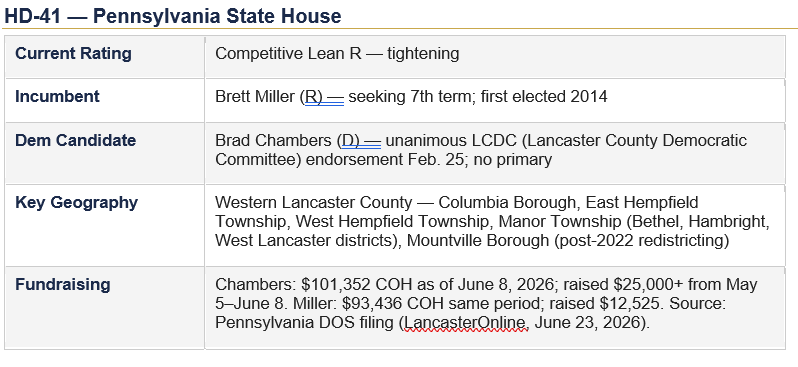
Miller has held HD-41 since 2014 — six consecutive terms. His 2024 margin of approximately 11 points reflects a structurally Republican-leaning district. The 2026 path for Chambers runs through the favorable national environment, the accountability frame on Miller's record, and the organizational advantage of running in the same geography where LCDC (Lancaster County Democratic Committee) chair Michael Mezzetti chairs the Hempfield Area Democratic Committee. As of June 8, 2026, Chambers held $101,352 cash on hand — outpacing six-term incumbent Brett Miller’s $93,436 by nearly $10,000 per Pennsylvania DOS filings reported by LancasterOnline on June 23. Chambers raised more than $25,000 between May 5 and June 8; Miller raised $12,525 in the same period. A challenger outpacing a six-term incumbent in both fundraising pace and cash on hand entering the fall is a meaningful organizational signal. The Working Families Party (WFP) identified HD-41 as a priority flip race for the general election. That geographic alignment between the new LCDC chair and the HD-41 battleground is an asset that was not available in prior cycles.
Miller's record on education funding, reproductive rights, and healthcare access is the accountability core. The message discipline required is consistent with every race in this portfolio: named votes, specific consequences, no fog. Miller's six-term incumbency means he has a long public record. He has simply never been required to defend it in a high-attention environment.
Watch List — August
• Miller public calendar: Any visible community events in August signal internal concern. Consistent absence since 2024 is itself an accountability data point.
• Chambers institutional endorsements: Labor and education endorsements before September signal organized infrastructure coming online.
State of the Race
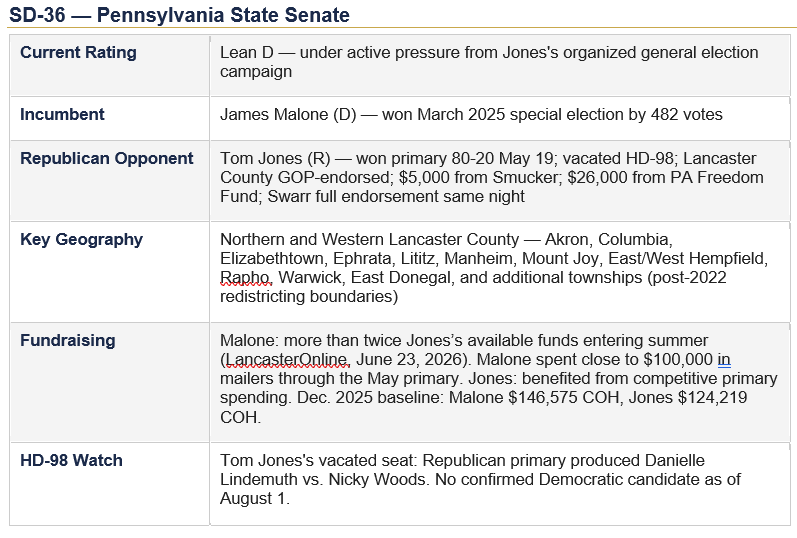
SD-36 is a genuine contest. Malone holds the seat won in March 2025 by 482 votes and enters the general election with a significant financial advantage: as of the June 8 Pennsylvania DOS filing, Malone holds more than twice the available funds of Republican challenger Tom Jones, per LancasterOnline reporting. Malone benefited from running unopposed in the May primary, preserving resources while Jones spent through a competitive primary. Tom Jones enters the general with a credential set that no prior Republican challenger in this district has carried: sitting HD-98 incumbent, Lancaster County Republican Committee endorsement, an existing voter file from overlapping geography, Freedom Caucus network support, Smucker's financial backing, and a unified Republican party behind him after an 80-20 primary win.
Malone's advantages are real. He has governed with visible local presence since March 2025. Incumbency is being built deliberately. The SD-36 townships of Lititz, Manheim Township, and East and West Hempfield have trended more Democratic in recent cycles. The SD-36 special election infrastructure — BVON (Black Voters on the Network)'s organizing anchor, Lancaster Stands Up's ward-level capacity — remains available. The national environment, with 1 in 5 reliable Republican base voters at risk in rural and suburban Pennsylvania, narrows Jones's turnout advantage.
The LCDC leadership variable is the most consequential unresolved organizational question in the portfolio. Malone backed the losing slate in the June 8 LCDC reorganization election — the candidate who lost 194-68 to Mezzetti. A general election campaign that requires the county committee's full organizational support is beginning with an internal endorsement split. Whether Malone and Mezzetti have built a functional working relationship in the eight weeks since the reorganization is the question PSI (Public Signal Institute) cannot yet answer from public sources.
The Smucker-Jones Connection
Lloyd Smucker's $5,000 contribution to Tom Jones connects the congressional Republican establishment directly to the most competitive state senate race in Lancaster County. The accountability inversion is available to Malone: 'Tom Jones took $5,000 from the congressman who voted to cut Medicaid for Lancaster County families. I'm not the one connected to Washington's agenda.' That is a direct, specific, documentable line — and it ties Jones to Smucker's record on every vote PSI has been tracking since April.
HD-98: Secondary Watch
Tom Jones's departure from HD-98 produced a Republican primary between Danielle Lindemuth and Nicky Woods. Nicky Woods won the primary and will be the nominee. Hugh Darlington is the Democratic candidate. An open seat in a cycle with a Democratic +6 generic ballot and a 1-in-5 Republican base enthusiasm problem is an opportunity for a flip.
Watch List — August
• Malone-Mezzetti coordination: First public joint activity signals whether the internal endorsement split has been absorbed into a functioning general election partnership.
• Jones general election messaging: Jones won his primary on a Freedom Caucus-adjacent platform. Watch whether he pivots to a local economic message for the general — school budgets, utility costs, agricultural concerns in Rapho and Warwick townships — or continues with the primary message.
• State fundraising — Oct. 15: First Q2 picture for both Malone and Jones. The gap between $146K and $124K COH from December 2025 will have moved significantly. Watch for Freedom Caucus network contributions to Jones.
Analyst Notes — August 2026
What Moves the Map
Shapiro's margin remains the structural floor for every race in this portfolio. He won Perry's district in 2022 with 50 percent turnout — unprecedented in a midterm. His 60 percent approval and his integration of the congressional pickup effort into his reelection campaign is the most important single variable no candidate in the portfolio controls but every candidate depends on.
The air war is the new variable entering August. The Harrisburg DMA is now carrying $6.4 million in reserved super PAC spending — HMP for Democrats, CLF for Republicans. The first candidate to define the frame in that market often holds it through November. Stelson's cash-on-hand advantage and the coordinated spending decision both argue for moving early. The question is whether HMP's reservation and Stelson's campaign committee buy the same frame or create a message gap that Perry can fill.
The enthusiasm gap, measured at 10 points among certain voters by WaPo/Ipsos, is the turnout model variable. AFP Action is at the door in swing states attempting to close it. Democratic campaigns in the portfolio — Stelson, Branas, Chambers, Malone — need to be at the door in their districts doing the same math in reverse: finding the 1-in-5 at-risk Republican base voter and moving them to abstention. That is field organizing, not advertising. And field organizing in August is the work that produces results in November.
Ninety-three days. The environment is the most favorable for Democrats since 2008. The candidates are set. The air war is opening. The field operation is the remaining variable. Execution is the answer.
Economic Indictment Frame — Confirmed Data for Candidate Use
Five data points confirmed against primary sources for deployment in candidate communications across all PSI portfolio races:
• PCE (Personal Consumption Expenditures) inflation: 3.8 percent annualized in April 2026 — fastest pace since May 2023 (Bureau of Economic Analysis). June CPI (Consumer Price Index): 3.5 percent overall; food at home +2.7 percent; food away from home +3.4 percent; electricity +4.0 percent; gasoline +26.7 percent year over year (Bureau of Labor Statistics)
• Q1 2026 GDP (Gross Domestic Product): 1.6 percent annualized — economy slowing while prices accelerate (Bureau of Economic Analysis)
• Real wages: -0.3 percent April 2025 to April 2026 — inflation outpacing earnings (Bureau of Labor Statistics, seasonally adjusted)
• Credit card delinquencies (90+ days): 13.12 percent Q1 2026 — highest since 2008 financial crisis (New York Federal Reserve)
• University of Michigan consumer sentiment: lowest since 1978 — worse than 2008, worse than COVID, worse than early 1980s stagflation
Pennsylvania Utility Signal — Locally Deployable Data: PPL customers received a distribution-rate increase of approximately $7.42 per month (4.9 percent) effective July 2026, with PPL’s residential Price to Compare moving to approximately 13.08 cents per kWh (kilowatt-hour) for July through November. PECO residential generation costs increased approximately 5 percent in the June reset. UGI and FirstEnergy territories saw significantly larger increases. The political effect is cumulative: Pennsylvania voters experience electricity, gasoline and groceries as one household-cost problem, not as separate economic categories. In HD-97, Steve Mentzer accepted utility company PAC (Political Action Committee) contributions from 2018 to 2024 while these rates were being set. That connection is Tier 1 accountability content — documented, sourced, and deployable. Perry, Smucker, Mentzer, and Miller all carry voting records directly connected to these conditions. Named votes, specific consequences, no fog.
PUBLIC SIGNAL INSTITUTE · HORSERACE REPORT · AUGUST 1, 2026
Produced by the Public Signal Institute. All race assessments reflect publicly available information as of August 1, 2026. All district boundaries reflect post-2022 Pennsylvania redistricting maps certified by the Pennsylvania Supreme Court