
You Been Had-Lifting the Veil No. 3
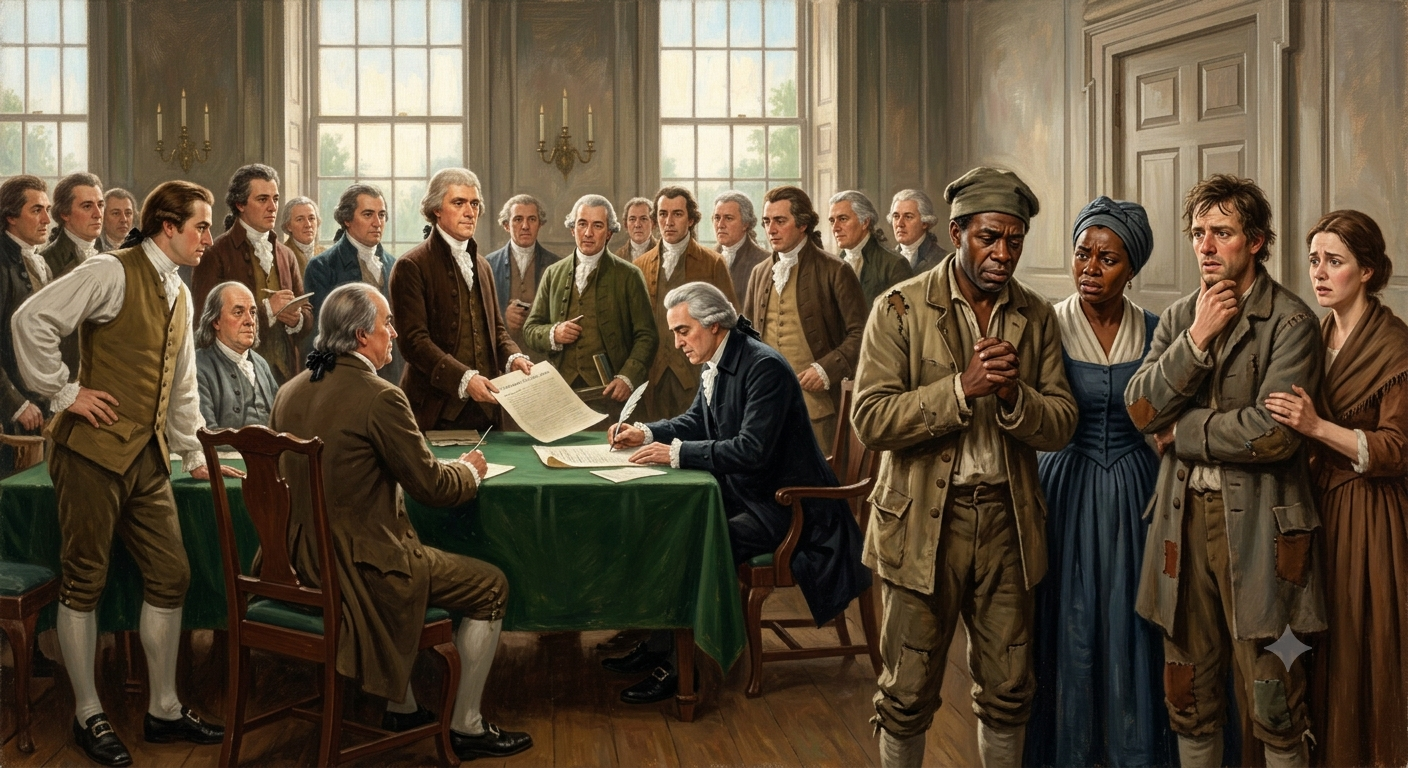
You Been Had
I own an American flag and a Marine Corps flag. I used to proudly display those flags on national holidays. On more occasions than I can remember, I marched in parades on the Fourth of July. I took pictures of my flags, framed the Instagram post with patriotic phrases, and posted Facebook pictures of me in uniform.
The first time this country elected Trump, I found myself questioning whether my patriotism was warranted. Then we had four years of Biden and his narrative that America was back. He was wrong, and the country reelected Trump. I was stunned and dismayed. I began to reflect on Malcolm X's famous phrase: "You have been had! You been hoodwinked! Bamboozled! Led astray!..." Was he right?
The problem is that America's celebration of the Fourth of July is built on Instagram moments, Hallmark cards, and short reel videos. As I began to reflect on my waning patriotism, I started to reread the document and study its history. I found that scholars have been writing about the hypocrisy of the Declaration of Independence for decades. You can start with Frederick Douglass's famous speech, "What to the Slave is the Fourth of July?" where he asked whether the great principles of political freedom and natural justice embodied in the Declaration extend to the enslaved. The answer is obvious: no.
My own need to embrace Instagram America was so great that I originally explained the Founding Fathers' silence on slavery as a lack of "political imagination" — the idea that they simply couldn't conceive of a world without slavery or without a white male monopoly on the vote, that the moral architecture of their time didn't yet contain the blueprint for something better. It's a comfortable explanation. It turns a choice into a limitation, and a limitation is easier to forgive than a choice. But that was wrong. My research shows the Founders considered denouncing slavery outright. Jefferson's original draft of the Declaration included a 168-word passage charging the King with waging "cruel war against human nature itself" by trafficking enslaved people across the Atlantic — language Jefferson himself called a "piratical warfare" and an "execrable commerce." The Continental Congress struck it, and Jefferson later blamed delegates from South Carolina and Georgia, along with Northern merchants who had grown wealthy carrying enslaved people across the ocean themselves. It wasn't an oversight. It was a bargain.
The same pattern holds for suffrage, though it played out less as a single clean decision than as a series of smaller ones, each closing a door partway. In March 1776, Abigail Adams wrote to her husband John, then drafting revolutionary law in Philadelphia, asking him to "remember the ladies" and warning that women would "foment a rebellion" if the new code of laws left them no voice. John wrote back treating the whole idea as a joke — though in private correspondence with a Massachusetts judge that same spring, he admitted he had no principled answer for why the "whole community of every age, rank, sex, and condition" shouldn't have a right to vote, only that extending it seemed impossible to him. He didn't resolve the contradiction. He set it aside. Decades later, delegates to the Constitutional Convention had a similar argument about property, not sex, debating whether only landowners should vote at all, and left the question of who else might vote to the states rather than settle it themselves. Only one state briefly remembered the ladies: New Jersey let women landowners vote starting in 1776 — not by grand design, but almost by accident of statutory wording — until party politics stripped that right away roughly thirty years later, after women's votes started swinging elections the wrong way for the men in power. Piece by piece, across a state legislature here and a convention room there, the Founders and their successors were repeatedly presented with the question of who else might belong, and repeatedly, by inaction as much as by vote, they let the answer stay narrow.
So here we are on the Fourth of July, 2026, and the Trump administration is attempting to redefine citizenship. National polling averages in early July 2026 — RealClearPolitics, Economist/YouGov, PBS News/NPR/Marist, and Emerson College among them — put his approval in the high 30s, roughly 37 percent, with Quinnipiac's poll running lower still at 34 percent. Either figure sits well below the 49.8 percent of the popular vote he won in 2024, a gap of 13 to 16 points. That gap is the story: a shrinking core still approves, while a much larger share of the country that once voted for him has pulled back. Another share of the country watches him and his sycophants break the rules, the ethical standards, and the law, hoping that somehow they will benefit by playing along.
So I have come to believe that the story of Black people in America is a story of resistance, perseverance, and struggle. The story remains to be told. It is not done. But the story is a tragedy, not a patriotic marching song.
So we must continue to Lift the Veil. The name comes from W.E.B. Du Bois, who wrote of Black Americans living behind a veil — seen by the rest of the country only through distortion, rarely as full participants in the nation's own story. To lift the veil is to insist on the fuller, harder history underneath. We must resist being hoodwinked or bamboozled. We must continue to study and understand that the idea of America changed the world for the benefit of humanity. The reality of America has fallen short of the dream, and the country is now debating whether to move toward a more perfect union or simply embrace the hypocrisy as who we really are.