
I. Where Things Stand — June 1, 2026
Pennsylvania’s general election field is fully set. The May 19, 2026 primaries resolved the last candidate uncertainty across the state’s competitive congressional and legislative landscape. Every race covered in this report now enters a five-month general election phase running to November 3, 2026.
Three conditions are defining the political environment as of June 1. Presidential approval has fallen to the lowest sustained levels of either Trump term, with five independent national pollsters simultaneously recording new-term lows in May. The national economic data arriving this spring — slowing growth, rising prices, falling real wages, and credit stress at levels not seen since 2008 — is registering in voter sentiment surveys at historically negative levels. And Pennsylvania Democrats emerged from the primary season with greater organizational coherence than at any point since 2018, while Republicans retain structural district advantages across most of the contested races.
The combination produces a competitive environment in which neither party holds a commanding position. Republican incumbents and nominees carry party registration advantages and established district networks. Democrats enter the general election with a favorable national environment, Governor Josh Shapiro’s statewide platform, and a primary season that produced nominees without damaging intraparty conflict in key races.
II. National Political Environment
Presidential Approval
Donald Trump’s job approval reached its lowest sustained levels of either presidential term in May 2026, with five major national pollsters recording new-term lows within the same two-week window. The figures cluster between 31% and 39%, with a composite average of 38.7% approval and 58.3% disapproval — a net of -19.6 points.
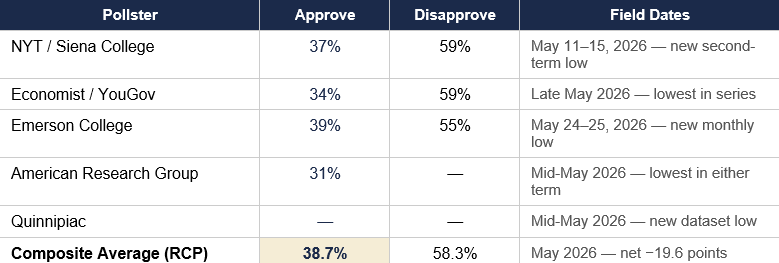
Among independent voters specifically, approval stands at 34% in aggregated polling from Gallup, Reuters/Ipsos, YouGov, Quinnipiac, and Morning Consult. CNN characterized Trump as “the weakest president this century” at this stage of a second term, measured by net approval. The only modern presidential second term with comparable approval erosion at this stage was Richard Nixon’s in late 1973.
The generic congressional ballot shows Democrats with a 4.8-point advantage over Republicans in the RealClearPolitics aggregate as of June 1.
Economic Conditions
The economic data entering the summer of 2026 presents a picture of sustained household pressure:
• PCE inflation: 3.8% annualized in April 2026, the fastest rate since May 2023, driven by energy costs and tariff-affected consumer goods.
• GDP: Q1 2026 revised down to 1.6% annualized growth, creating a stagflation-adjacent dynamic of rising prices and slowing output.
• Real wages: down 0.3% year-over-year through April 2026 (Bureau of Labor Statistics), meaning the average worker’s purchasing power fell while prices rose.
• Credit card delinquencies: 13.12% at 90 days as of Q1 2026, the highest reading since 2008 (Federal Reserve Bank of New York).
• Consumer sentiment: University of Michigan index at its lowest reading since 1978, reflecting how households assess their own financial conditions.
• SNAP enrollment: 700,000 fewer children enrolled across 12 states following Republican-led cuts; approximately 144,000 Pennsylvania residents face reduced or eliminated benefits under the One Big Beautiful Bill.
University of Michigan consumer sentiment at a 48-year low and credit delinquencies at a 17-year high together represent a household stress picture that has not been present in a midterm election year since 2010. Historically, economic conditions of this kind have correlated with significant losses for the president’s party in congressional elections.
III. Pennsylvania Statewide
Governor: Josh Shapiro (D) vs. Stacy Garrity (R)
Both candidates emerged from the May 19 primary without opposition. The general election is set.

Josh Shapiro, Pennsylvania’s second-term Democratic governor, enters the general election as the dominant figure in Pennsylvania politics. He has endorsed Democratic nominees in key swing-district congressional races, travels the state as a surrogate, and is the subject of active national speculation about 2028 presidential positioning (Washington Post, May 22, 2026). Shapiro’s approval ratings have consistently outpaced national Democratic figures in Pennsylvania polling.
Stacy Garrity, Pennsylvania’s State Treasurer, is the Republican nominee. Garrity has a strong record of voter support in statewide treasurer races but faces a recognition gap outside Republican primary circles in a race against a sitting governor with a built-in institutional platform. Republicans will need a significant shift in the national environment or a Garrity breakout moment to make the governor’s race competitive.
Philadelphia’s 3rd Congressional District: Outcome Set
The May 19 primary in Pennsylvania’s 3rd Congressional District — covering approximately half of Philadelphia — produced a decisive result. State Rep. Chris Rabb won the Democratic primary with 44% of the vote in a three-way race, defeating State Sen. Sharif Street (29.5%) and physician Ala Stanford (24%). With no Republican candidate on the November ballot, Rabb is the next U.S. Representative from PA-3.
Rabb, a five-term state representative from East Mount Airy, ran on an explicitly progressive platform. His campaign mobilized a coalition of Philadelphia-based progressive organizations, knocked approximately 120,000 doors, and received $1 million in outside advertising support from national progressive groups in the race’s final week. He won decisively in Northwest Philadelphia and dominated majority-white, higher-income precincts while running competitively in majority-Black wards.
IV. PA-10 — Perry vs. Stelson
Pennsylvania’s 10th Congressional District, centered in the Harrisburg region, is one of the most closely watched congressional contests in the country.

Scott Perry (R) — Incumbent
Scott Perry is seeking his eighth term representing PA-10. He served as chair of the House Freedom Caucus and has been a prominent figure in Republican congressional politics. Perry’s tenure includes several significant political events that have generated sustained national attention: he was a leading voice opposing certification of the 2020 presidential election results; Department of Justice agents seized his personal cell phone in August 2022 as part of the January 6 investigation; and he sought a presidential pardon in connection with his January 6 activity. Perry has maintained strong support within the district’s Republican base through these controversies.
Perry enters the general election with the structural advantages of incumbency, a well-established fundraising network, and a district that has leaned Republican. He has won seven consecutive terms.
Janelle Stelson (D) — Challenger
Janelle Stelson, a former television news anchor with regional name recognition across the PA-10 media market, ran against Perry in 2024 and narrowed the margin considerably in what had been a reliably Republican seat. That campaign produced donor lists, volunteer infrastructure, and precinct-level data that her 2026 campaign inherited on day one. She is the DCCC’s highest-priority Pennsylvania target and has the backing of Governor Shapiro’s organization.
Race Trajectory
PA-10 is trending more competitive than its baseline suggests. The district’s suburban and exurban composition makes it sensitive to shifts in independent voter sentiment, which has moved sharply against Republicans nationally. Perry’s profile — tied to the January 6 investigation and the House Freedom Caucus’s confrontational posture — gives Democratic arguments specific local application in a district that includes a significant population of college-educated suburban voters who have trended away from Trump-aligned Republicans since 2018.
Cook Political Report rates the race as a toss-up. The DCCC has designated PA-10 a top national target. Stelson’s prior campaign infrastructure and the favorable national environment give Democrats a credible path to flipping this seat for the first time in over a decade. Perry’s incumbency and the district’s registration advantage keep Republicans competitive.
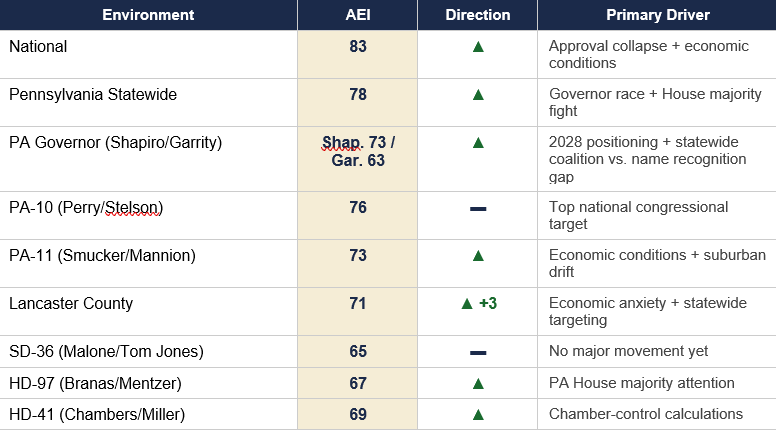
AEI: 76 — Pennsylvania’s highest-attention congressional race outside Philadelphia. Direction: stable at high competition level.
V. PA-11 — Smucker vs. Mannion
Pennsylvania’s 11th Congressional District covers Lancaster and York Counties and is a traditionally Republican seat now drawing competitive attention

Lloyd Smucker (R) — Incumbent
Lloyd Smucker is the incumbent representative for PA-11, a district anchored in Lancaster County that has returned Republican representatives to Congress without interruption for decades. Smucker holds the structural advantages of incumbency in a district with a significant Republican registration edge and a deep institutional network in Lancaster County Republican politics.
Nancy Mannion (D) — Challenger
Nancy Mannion is the Democratic nominee. The district’s suburban precincts in Lancaster and York Counties — particularly those that shifted toward Shapiro in the 2022 governor’s race — represent the Democratic path to competitiveness in a district that otherwise favors Republicans.
Race Trajectory
PA-11 is trending more competitive relative to its historical baseline, driven by two factors. First, suburban Lancaster County has shown measurable movement toward Democrats in recent statewide cycles, consistent with the national pattern of college-educated suburban voters shifting away from Trump-aligned Republicanism. Second, the economic environment — tariff-driven inflation, real wage erosion, and SNAP cuts affecting Pennsylvania families — provides Democratic challengers with material that reaches voters whose economic concerns outweigh their partisan default.
PA-11 remains a Republican-leaning seat. A Democratic win would require both a strong turnout operation and measurable persuasion of Republican-leaning independents who have not previously supported Democratic congressional candidates in this district.
AEI: 73 — Rising. Economic conditions and suburban drift are increasing competitive attention.
VI. Lancaster County Political Overview
Lancaster County remains one of Pennsylvania’s most reliably Republican jurisdictions at the federal and state legislative levels. Republicans hold substantial voter registration advantages across most of the county’s legislative districts. However, the county has shown directional movement in recent cycles — most dramatically in the March 2025 SD-36 special election — that has drawn increased attention from both parties heading into November.
The economic issues registering most prominently in Lancaster County political conversations as of June 2026 include utility costs, housing affordability, agricultural input prices, and health care access. These issues are present across party lines and generation groups, reflecting a broader pattern in which economic anxiety has become the dominant organizing concern for Pennsylvania voters regardless of geographic or demographic category.
Lancaster County AEI: 71 — Up 3 points from May. Driven by elevated economic anxiety and increased statewide campaign attention to suburban and exurban voters.
VII. SD-36 — Malone vs. Tom Jones
Pennsylvania’s 36th State Senate District, covering northern and western Lancaster County, is the site of one of the state’s most closely watched legislative races.

James Malone (D) — Incumbent
James Malone won the SD-36 seat in a March 25, 2025 special election that LNP | LancasterOnline called “the most significant political upset in Lancaster County history.” Malone, the former two-term mayor of East Petersburg Borough, defeated Republican Josh Parsons by 482 votes in a district Donald Trump carried by 15 points in the 2024 presidential election. The victory made Malone the first Democrat to represent the district in the Pennsylvania Senate since 1889 — more than 136 years.
Malone enters the 2026 general election as the defending incumbent but the structural underdog. The district’s voter registration is approximately 53% Republican and 30% Democratic, and its presidential performance reflects deep Republican roots in Lancaster County’s farming communities and borough networks. Malone’s special election win was achieved at 29% turnout — a special-election electorate in which motivated Democrats and ticket-splitters turned out at disproportionate rates. He has DLCC support for his reelection campaign.
Tom Jones (R) — Challenger
Tom Jones, who represented Pennsylvania’s 98th House District, gave up his House seat to run for the SD-36 Senate seat — a decision that signals the Republican Party’s institutional commitment to reclaiming this seat. Jones defeated former Rapho Township supervisor Jere Swarr in the May 19, 2026 Republican primary. His platform centers on tax reduction, opposition to abortion rights, and term limits. Jones enters the general election with the advantage of running in a district whose registration and presidential performance align with Republican candidates.
Race Trajectory
SD-36 is the most politically significant state legislative race in Lancaster County. Republicans are favored given the structural registration advantage and the presidential baseline. However, Malone’s incumbency — even in a one-year term — provides visibility and institutional access that challengers typically lack. The race will test whether Malone’s 2025 coalition — which drew Democrats, independents, and ticket-splitting Republicans — can be reassembled at general-election turnout levels, where Republican registration advantages become more determinative.
Tom Jones’ departure from HD-98 also creates an open House seat in northern Lancaster County that will draw its own competitive attention.
AEI: 65 — Stable. Expected to rise as both campaigns build toward fall.
VIII. HD-97 — Branas vs. Mentzer
Pennsylvania’s 97th House District covers southern Lancaster County, including Conestoga, East Lampeter, West Lampeter, Pequea, and portions of Manheim and Manor townships. It is one of several targeted districts in the battle for Pennsylvania House majority control

Steve Mentzer (R) — Incumbent
Steve Mentzer has represented HD-97 for twelve years. He is the Republican incumbent in a district that has consistently returned Republican representatives. Mentzer’s legislative record includes committee work on education and agriculture issues relevant to the district’s makeup.
Jess Branas (D) — Challenger
Jess Branas is the Democratic nominee. The district’s precinct geography includes education-concentrated communities in East and West Lampeter that have shown increased Democratic performance in recent statewide cycles.
Race Trajectory
HD-97 has attracted attention beyond its individual competitive profile because of its role in the Pennsylvania House majority calculation. Democrats currently hold the Pennsylvania House by a single seat, which means every competitive district carries chamber-level stakes for both parties. Democrats must defend their slim majority while Republicans see HD-97 as part of a path back to House control.
The district’s southern Lancaster County geography — a mix of residential and agricultural communities — gives economic issues including utility costs and agricultural input prices direct local relevance. Mentzer’s twelve-year tenure in a district where those costs have risen makes his incumbency both an asset and a target.
AEI: 67 — Rising, driven by statewide attention to Pennsylvania House majority control.
IX. HD-41 — Chambers vs. Miller
Pennsylvania’s 41st House District covers western Lancaster County, including Columbia Borough, Mountville Borough, East Hempfield, West Hempfield, and portions of Manor Township.

Brett Miller (R) — Incumbent
Brett Miller has represented HD-41 since 2014 and is seeking his seventh term. He is a reliable Republican incumbent in a district that has returned Republican representatives consistently. Miller’s long tenure provides incumbency advantages in name recognition, constituent service networks, and fundraising.
Brad Chambers (D) — Challenger
Brad Chambers, a labor administrator from Columbia Borough, is the Democratic nominee. He ran against Miller in 2024 and lost by approximately 4,000 votes — 55.67% to 44.33% — a closer margin than the district had seen in years. That campaign produced door-knocking infrastructure, a donor base, and district-wide name recognition that Chambers carries into his second run. He has received the endorsement of U.S. Senator Bernie Sanders among others heading into the 2026 general election.
Race Trajectory
HD-41 is a Republican-held seat with a structural advantage that makes a Democratic flip unlikely under current polling and registration conditions. However, the race has drawn attention because of its position in the Pennsylvania House majority calculation, where both parties are treating every competitive seat as consequential. Chambers’ campaign has the potential to force Miller to spend resources on a district he would ordinarily hold without significant contest, which has value in a chamber-control environment where Republican resource allocation matters.
Precinct-level data from the 2022 governor’s race shows Shapiro outperforming his statewide baseline in several HD-41 communities, suggesting some ticket-splitting appetite that Democrats are working to activate in 2026.
AEI: 69 — Rising incrementally. Chamber-control calculations are driving outside attention to a district that would otherwise see less.
X. Attention Economy Index (AEI) — June 2026 Scorecard
The Attention Economy Index (AEI) is a Public Signal Institute measure of the volume and direction of political attention in each environment, scored from 0 (dormant) to 100 (saturation). Scores above 80 indicate environments where the dominant political frame shapes voter attention more than individual candidate activity. Scores from 65 to 79 indicate active competitive environments where candidate decisions can meaningfully move outcomes.
XI. What to Watch — Key Indicators Before November
Several developments between now and November will be most consequential for the competitive races in this report:
• Q2 fundraising reports (due July 15): Federal FEC and Pennsylvania DOS semi-annual filings will show whether competitive nominees across PA-10, PA-11, SD-36, HD-97, and HD-41 have built the financial resources to compete through November. The fundraising gap between candidates will shape advertising and field capacity in the fall.
• Presidential approval trajectory: If Trump’s approval continues to decline or stabilizes at current levels below 40%, the national environment sustains Democratic structural advantage in competitive districts. A recovery toward 43–45% would narrow that advantage significantly. Independent voter approval is the critical variable.
• Economic data: PCE inflation, GDP revision, and consumer sentiment readings through summer will determine whether the economic environment strengthens, holds, or shifts. A sustained above-3% inflation reading through October, combined with stagnant real wages, would maintain the current electoral environment. A visible economic improvement would benefit Republicans.
• Pennsylvania House dynamics: With Democrats holding a one-seat majority in the Pennsylvania House, any vacancy or special election before November could alter the chamber-control stakes that are driving outside attention to HD-97 and HD-41. Tom Jones’ departure from HD-98 to run for Senate also creates an open seat in adjacent northern Lancaster County.
• SD-36 registration and turnout: Malone’s 2025 win came at 29% special-election turnout. The November general election will bring significantly higher turnout, activating more of the district’s 53% Republican registration. How that increased volume affects the competitive margin is the central empirical question in this race.
Public Signal Institute • June 11, 2026 Horse Race • Public Edition
Pennsylvania Political Intelligence • publicsignalinstitute.org