
THE HORSE RACE — 2026 Midterm Election Status Report

FROM: The Black Voter Outreach Network Research Division
Nine months out from Election Day, the 2026 midterms have moved from “next year” to a measurable, shifting contest. The Horse Race is a monthly tracking memo produced by the Black Voter Outreach Network of PA’s Research Division—a straight read of the political environment using the indicators that shape outcomes: presidential approval, the generic ballot, major issue pressures (like costs, SNAP, and healthcare), and what those signals suggest for control of Congress and for key fights in Pennsylvania. It’s not prediction or punditry—just a consistent, evidence-based snapshot of where things stand and what’s changing, updated each month.

I. THE NATIONAL ENVIRONMENT
Nine months before Election Day, the political environment is tilting decisively in favor of Democrats. The structural dynamics of a midterm election under an unpopular president are compounded by issue-specific vulnerabilities for the Republican majority.
Presidential Approval: Trump’s job approval has deteriorated to its lowest sustained levels of his second term. The New York Times tracker (Feb. 16) shows 40% approve / 56% disapprove—his lowest rating so far this term. Pew Research (January 2026) places approval at 37%. AP-NORC (February 5–8) registers 36% approval and 62% disapproval. The Nate Silver/Silver Bulletin aggregate sits at approximately -13.7 net approval as of February 9, with the share of Americans who “strongly disapprove” breaking 46% for the first time.
NYT/Siena polling reveals a critical income split: Trump’s approval is just 36% among voters making less than $50,000 per year, compared to 44% among higher earners.
Economic dissatisfaction that helped propel Trump’s gains among lower-income voters in 2024 is now rolling those gains back. On economic blame, voters are split: 35% blame Biden for the biggest economic challenges, 31% blame Trump, and 33% say neither—a remarkable finding given how poorly Trump rates on the economy overall.
Generic Congressional Ballot: Democrats hold a consistent lead. Fox News (January 23–26) shows Democrats ahead 52% to 46%. Harvard CAPS/Harris reports an 8-point Democratic lead among registered voters and 4 points among likely voters. Morning Consult’s weekly tracker (February 2–8) registers Democrats +3 (45% to 42%). The Democratic advantage is widening among women, Gen Z voters, and independents.
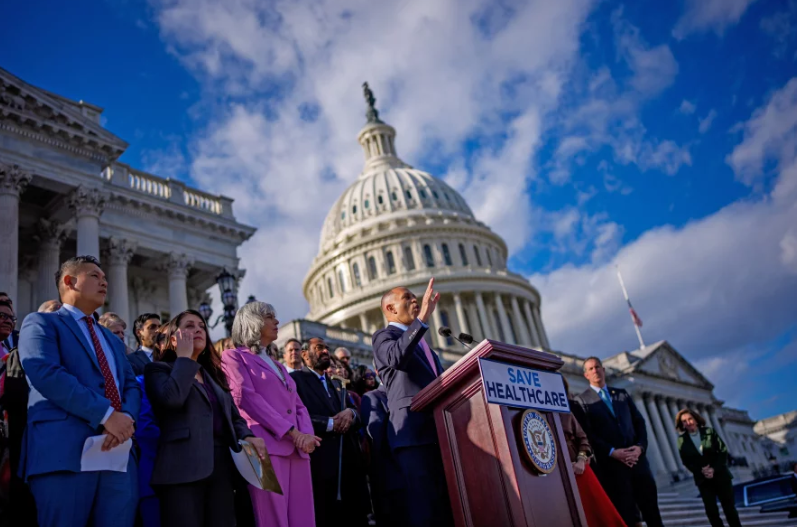
Key Issue Dynamics: Democrats are favored on healthcare (+21), affordability (+14), helping the middle class (+14), and vaccines (+16). Republicans retain advantages on border security (+15) and national security (+12), but have lost their edge on taxes, foreign policy, and the federal deficit. Voter anxiety over Social Security, Medicare, and Medicaid cuts is creating acute vulnerabilities for Republican incumbents. The tariff disruptions and SNAP benefit reductions are particularly salient in swing districts.
Grocery Prices & Food Security: The cumulative grocery price increase since March 2020 is 29.4% (BLS CPI Food at Home). A family spending $600/month on groceries pre-pandemic now pays roughly $776 for the same basket. The January 2026 CPI (released February 13) shows food prices up 2.9% year-over-year, with grocery-specific inflation at 2.1%. The USDA forecasts food-at-home prices to rise another 1.7% in 2026. But the topline numbers obscure acute pain in kitchen-table categories: beef roasts are up 73.8% since 2020, ground beef up 52.5%, coffee and tea up 11.8% in 2025 alone, and sugar/sweets projected to jump 6.7% in 2026.
Meanwhile, the Republican reconciliation bill (“One Big Beautiful Bill Act,” enacted July 4, 2025) is slashing SNAP benefits through expanded work requirements and elimination of the energy assistance deduction. The average SNAP benefit in FY2026 is projected at just $6.40 per person per day—and the cuts will reduce it to approximately $5.00. Nearly 42 million Americans rely on SNAP, and the CBPP estimates half a million additional people will experience benefit cuts, including children, people with disabilities, and older adults. During the government shutdown, SNAP allotments were temporarily cut to 65% of normal levels. This collision—cumulative grocery inflation that never reversed, plus active benefit cuts targeting the lowest-income households—is the single most potent affordability issue heading into November, and it relates directly to an amazing data point The latest poll has Trump at 36% approval among voters under $50K, who prefer Democrats for Congress by 12 points.
Historical Pattern: The party holding the White House has lost House seats in 19 of the last 21 midterm elections. NYT chief political analyst Nate Cohn writes (Feb. 16) that if the only thing you knew was Trump’s 40% approval rating and the number of Republican-held seats, you would project Republicans losing approximately 30 House seats. Crucially, Cohn argues that the 2022 exception—when Democrats held their own despite Biden’s similar unpopularity—does not apply here. In 2022, the Dobbs decision and the January 6th aftermath shifted focus onto the out-of-power party. This cycle, there is no equivalent issue redirecting attention away from Trump. He is center stage, and Democratic Party weaknesses are “quite ordinary.”
The latest evidence: a Democrat won a Texas State Senate special election by double digits despite an R+19 electorate—a result driven not merely by turnout but by Republican-leaning voters crossing over. Voters making under $50,000 prefer Democrats for Congress by 12 points, while the race is tied among all other voters.
II. U.S. HOUSE OF REPRESENTATIVES
Current Composition: Republicans 220 — Democrats 215. Democrats need a net gain of just 3 seats to reclaim the majority.
Forecast: RacetotheWH gives Democrats approximately a 69% chance of winning the House majority, up from 64% before recent FEC fundraising data was incorporated. Democratic candidates are outraising Republican incumbents in individual-donor fundraising across many competitive districts, a historically predictive indicator of electoral success.
The competitive landscape is concentrated in suburban and swing districts, particularly in New York, California, and Pennsylvania. In Pennsylvania alone, four GOP-held districts (PA-01, PA-07, PA-08, PA-10) are rated as highly competitive, with all but PA-01 decided by 2% or less in 2024.
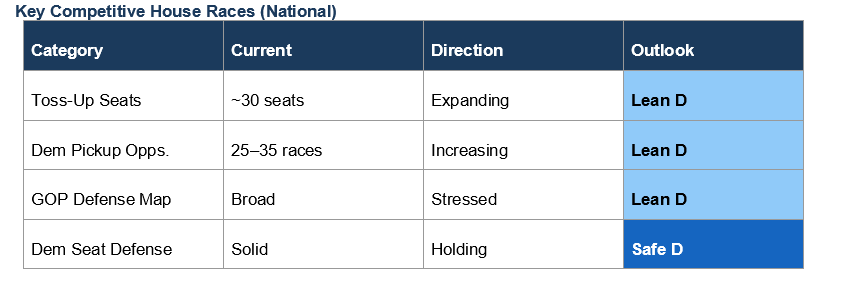
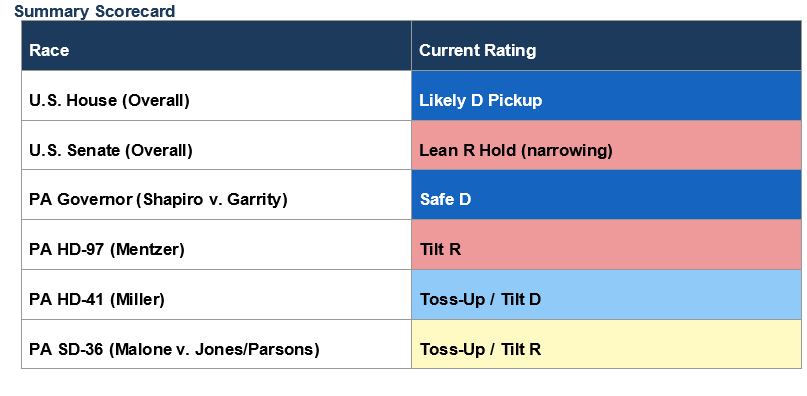
Assessment: LIKELY DEMOCRATIC PICKUP. Democrats are well-positioned to reclaim the House. The combination of a narrow GOP majority, Trump’s underwater approval, favorable fundraising trends, and the historical midterm penalty point to a Democratic majority in the 118th Congress. The question is margin, not direction.
III. U.S. SENATE
Current Composition: Republicans 53 — Democrats 47 (including 2 independents). Democrats need a net gain of 4 seats for outright control, or 3 seats plus the Vice Presidency (which they do not hold).
The 2026 map is far more favorable to Democrats than 2024 was. Of 35 seats up (including special elections in Florida and Ohio), 23 are held by Republicans. Key targets include:
Maine (Susan Collins, R): Collins faces a serious challenge. Democratic Gov. Janet Mills has entered the race. Cook and Inside Elections both rate this competitive. Collins won with 51% in 2020 in a state Biden carried.
Michigan (Open, D-retirement): Sen. Gary Peters’ retirement opens this seat. Multiple Democrats (Mallory McMorrow, Haley Stevens, Abdul El-Sayed) and Republican Mike Rogers are competing. This will be the most expensive Senate race in the nation.
Georgia (Jon Ossoff, D): Ossoff is a top GOP target after his narrow 2020 win. Recent ratings have shifted this from Toss-Up to Lean D as of late January.
Alaska, North Carolina, Iowa, Kansas, Kentucky (Open): Multiple Republican-held seats show varying degrees of competitiveness, with Alaska and North Carolina drawing the most attention from forecasters.
Florida & Ohio (Special Elections): Both special elections to fill Rubio’s and Vance’s seats add to the competitive landscape.
Assessment: COMPETITIVE BUT UPHILL FOR DEMOCRATS. The map favors Democratic gains, but flipping 4 seats while defending Michigan remains a heavy lift. The most likely outcome is Democrats gaining 1–3 seats, narrowing the margin without reaching the majority. A Democratic wave could put 50–50 in play, but that scenario requires virtually everything to break their way.
IV. PENNSYLVANIA GOVERNOR’S RACE
Incumbent: Gov. Josh Shapiro (D), seeking re-election to a second term. Formally announced January 8, 2026.
Likely Republican Nominee: State Treasurer Stacy Garrity. Endorsed by Donald Trump on January 27, 2026. Also endorsed by Sen. Scott Martin, Rep. Dan Meuser, and AG Dave Sunday.
Mastriano Out: State Sen. Doug Mastriano, the 2022 GOP nominee who lost to Shapiro by 15 points, announced on January 7, 2026 that he would not seek the nomination, stating “God has not called us to run for governor this year.” Notably, Mastriano declined to endorse Garrity, saying “we’ll talk about that down the road.” Rep. Dan Meuser also declined to run. This effectively clears the field for Garrity, with only Jason Richey (Allegheny County GOP Chair) offering token opposition. The consolidation of the Republican field around Garrity eliminates the risk of a bruising primary but also deprives the GOP of the grassroots energy Mastriano’s base could have generated.
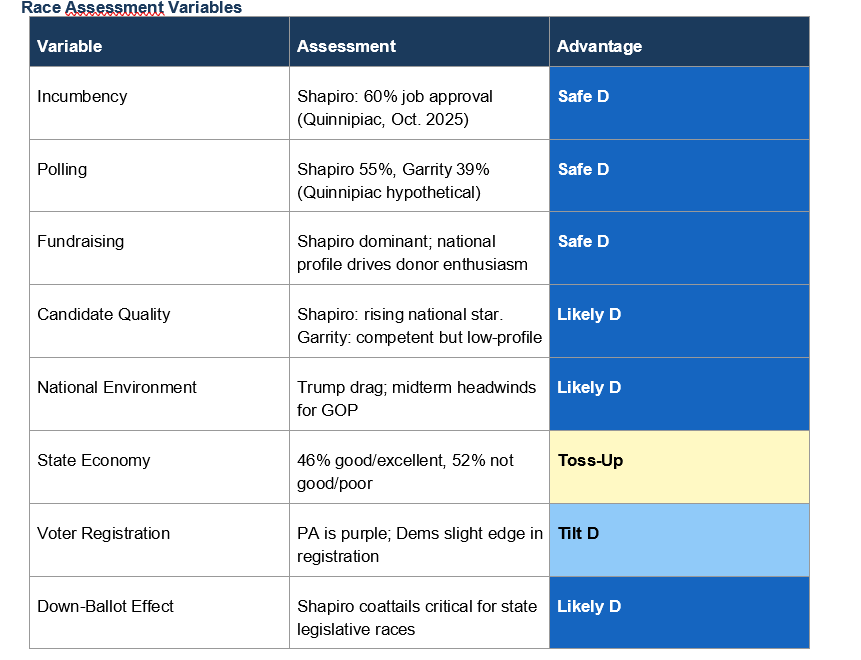
Assessment: SAFE DEMOCRATIC HOLD. Josh Shapiro is the strongest Democratic incumbent governor in the nation. His 60% approval, 16-point polling lead over Garrity, national fundraising capacity, and the favorable midterm environment make this race essentially uncompetitive barring a seismic event. Garrity is a more credible candidate than Mastriano was in 2022, but the fundamentals overwhelmingly favor Shapiro. His coattail effect on state legislative races below him is the most consequential dimension of this contest.
V. LANCASTER COUNTY — STATE LEGISLATIVE RACES
Lancaster County is emerging as one of the most consequential political battlegrounds in Pennsylvania for 2026. The March 2025 special election upset in the 36th Senate District—where Democrat James Malone defeated Republican Josh Parsons in a district Trump won by 15 points—has rewritten assumptions about competitiveness in this traditionally Republican stronghold.
A. State House District 97 (East Lampeter Township, Manheim Township, Pequea Township, West Lampeter Township)
Incumbent: Steven Mentzer (R), serving since 2013. Won re-election in 2024 over Democrat Bob Rudy.
District Profile: Covers Manheim Township, the most populous municipality in Lancaster County and one of its most suburbanizing areas. This is a classic suburban swing district where demographic trends are shifting toward Democrats.
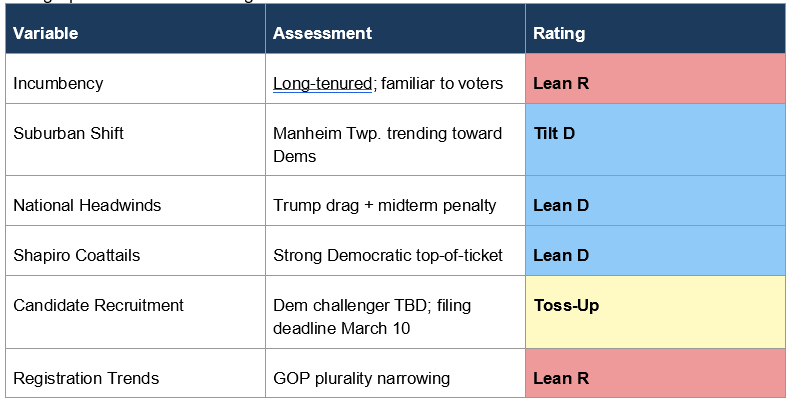
Assessment: COMPETITIVE — TILT REPUBLICAN. HD-97 is a prime pickup opportunity for Democrats IF they recruit a strong candidate. Mentzer’s longevity gives him a personal vote cushion, but the suburbanization of Manheim Township, combined with Shapiro’s coattails and the anti-Trump midterm environment, make this district genuinely competitive. The outcome will hinge on whether Lancaster County Democrats recruit a credible challenger who can capitalize on the shifting demographics. Without a strong candidate, the district stays Republican by default.
B. State House District 41 (East & West Hempfield, Columbia, Mountville)
Incumbent: Brett Miller (R), serving since 2015. Won re-election in 2024 over Democrat Brad Chambers. Sought the Republican nomination for the 36th Senate special election but lost to Josh Parsons. Chairs the House Local Government Committee.
District Profile: Covers East and West Hempfield Townships, Columbia and Mountville boroughs. Registration: approximately 46% Republican, 36% Democrat, 18% independent/third party. This is a suburban-small town district that overlaps significantly with the 36th Senate District where Malone’s upset occurred.
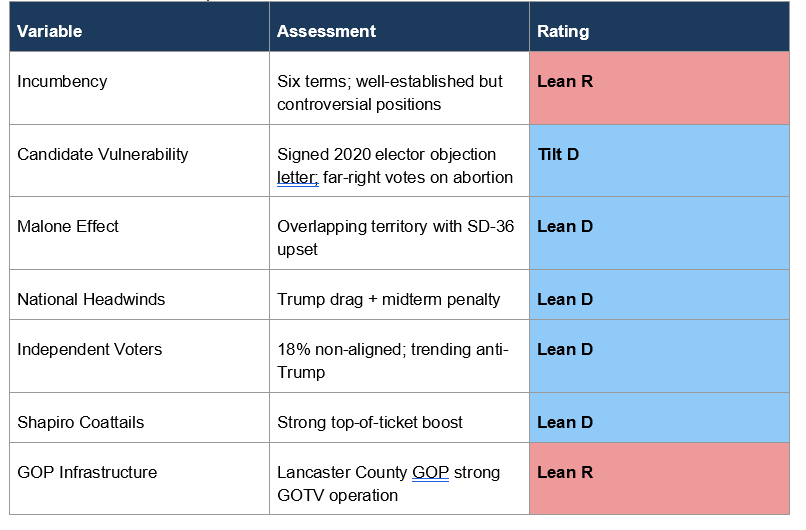
Assessment: COMPETITIVE — TOSS-UP / TILT DEMOCRATIC. HD-41 is the most flippable Lancaster County House seat for 2026. Miller’s 2020 elector objection letter and hardline positions on reproductive rights create openings with suburban women and independents—the exact voters who drove Malone’s upset in overlapping territory. The Malone effect proves these voters exist and will turn out. If Democrats field a candidate who can match Chambers’ 2024 energy or exceed it, this seat is genuinely in play. Miller’s failure to win the GOP Senate nomination may also signal weakening intra-party support. This is a race to watch.
C. State Senate District 36 (Northern Lancaster County)
Incumbent: James Malone (D), won March 2025 special election by 526 votes over Josh Parsons (R). First Democrat to represent this area in the State Senate since 1889. Has announced re-election bid.
Likely Republican Challenger: State Rep. Tom Jones (R-98th District), who announced his candidacy in 2025. Jones represents a large section of the 36th District. Josh Parsons may also seek a rematch but rumor has it that the local GOP members are not interested in a potential rematch.
District Profile: Covers 25 municipalities in northern Lancaster County, including Lititz, Ephrata, Elizabethtown, Columbia, Mount Joy, Manheim, and New Holland. Registration: 53% Republican, 30% Democrat, 17% other. Trump carried the district by 15 points in 2024.
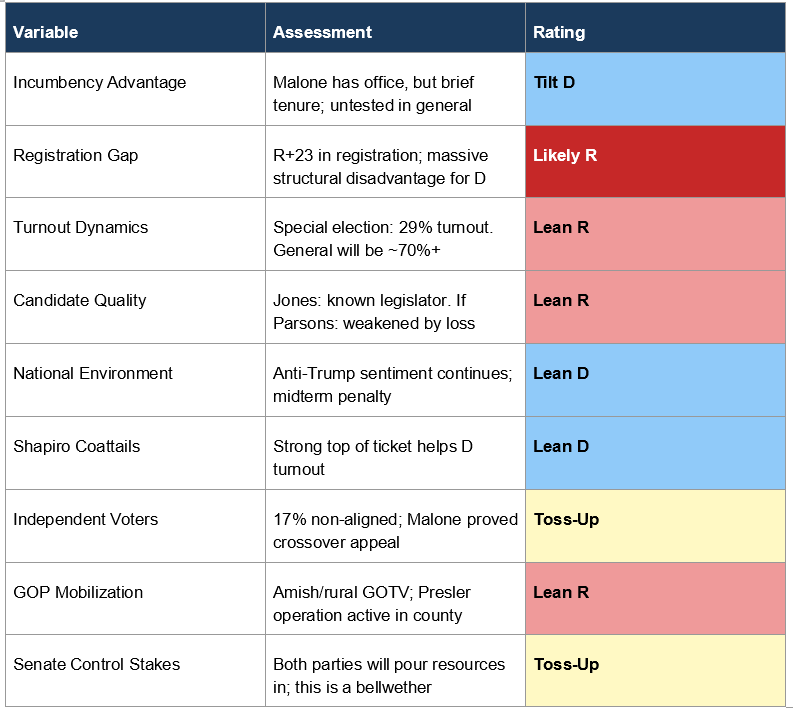
Assessment: COMPETITIVE — TOSS-UP / TILT REPUBLICAN. This is the marquee Lancaster County race of 2026. Republican strategists are confident they can reclaim it in a higher-turnout general election, pointing to the 23-point registration advantage. Christopher Nicholas, a veteran GOP consultant, noted: the low-turnout special election dynamic will not repeat, and Republicans will field a different candidate. However, Malone has incumbency, a compelling personal story, and the advantage of Shapiro’s coattails. The variables that drove his upset—voter anger at Trump-era policies, crossover Republican votes, and enthusiasm among independents—have not dissipated. If anything, they have intensified. This race will be a nationalized contest, with both parties investing heavily. The outcome may determine whether Democrats can reach 25–25 in the State Senate, with Lt. Gov. Austin Davis breaking ties.
VI. STRATEGIC ASSESSMENT & BOTTOM LINE
The 2026 midterm landscape, as of February 14, 2026, presents a political environment that structurally favors Democrats at every level analyzed in this memo. The convergence of an unpopular president, a motivated opposition electorate, a favorable Senate map, a razor-thin House majority, and a popular Democratic governor in Pennsylvania creates overlapping opportunities for Democratic gains.
The critical variable across all these races is the same: candidate quality and voter enthusiasm. The national environment provides the wind; local candidates must provide the sails. In Lancaster County specifically, the Malone upset has fundamentally altered the calculus. Democrats now have proof of concept that anti-Trump sentiment, crossover voting, and independent mobilization can produce wins even in deeply Republican territory. The question for November is whether that energy sustains through a higher-turnout general election.
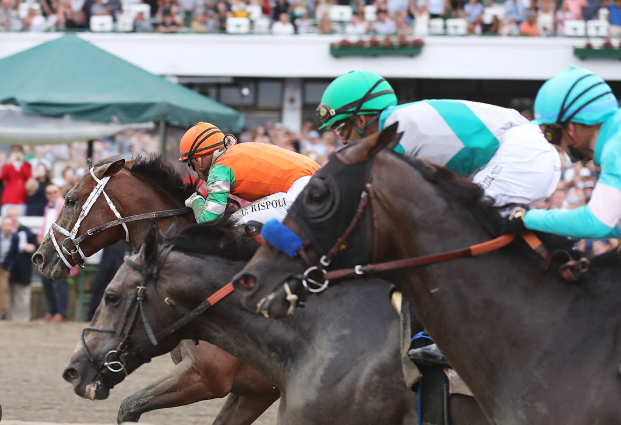
The horses are out of the gate. The race is on.
Sources: Quinnipiac University Poll, Pew Research Center, AP-NORC, Silver Bulletin, Harvard CAPS/Harris, Fox News Poll, Morning Consult, New York Times/Siena College, BLS Consumer Price Index, USDA Food Price Outlook, Center on Budget and Policy Priorities, RacetotheWH, Cook Political Report, Inside Elections, Sabato’s Crystal Ball, 270toWin, Spotlight PA, LNP/LancasterOnline, Ballotpedia, Pennsylvania Capital-Star.
