
POLITICAL INTELLIGENCE MAY HORSERACE REPORT
Pennsylvania District Portfolio
May 15, 2026 · 2026 Cycle · PUBLIC EDITION
Produced by the Public Signal Institute
PORTFOLIO SNAPSHOT — MAY 15, 2026
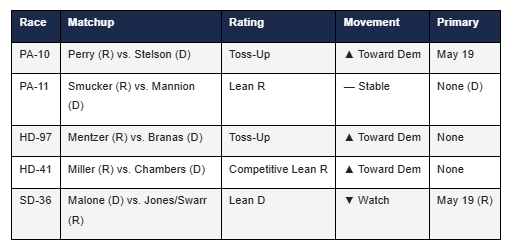
MAY ANALYST NOTE
Eighteen days out from the May 19 primary, the Pennsylvania portfolio is in motion. The national environment has not changed direction — it has continued to deepen. Trump's approval has fallen to 33 percent in the most recent AP-NORC poll, with disapproval at 57 percent — a record low for his second term. Democrats lead the generic congressional ballot by six points in the Silver Bulletin average as of late April. The Brookings Institution notes this is the first cycle since 2010 in which Democrats are more trusted than Republicans to handle the economy. That is a structural shift, not a polling fluctuation, and it runs through every competitive district in this portfolio.
The primary on May 19 is the first hard test. In PA-10, Stelson is the prohibitive frontrunner with a 40-to-1 fundraising advantage over Douglas and the full institutional weight of the party behind her. The primary has developed friction — Douglas is withholding endorsement commitments and Stelson declined multiple debate invitations — but the structural outcome is not in doubt. What matters after May 19 is whether the campaign emerges unified or carrying an internal credibility cost on immigration that Perry's operation will attempt to exploit.
In SD-36, the Republican primary on May 19 determines the threat level for the general. A Tom Jones win — the probable outcome given the Lancaster County GOP committee endorsement — means Malone faces a credentialed incumbent-level challenger with five months to organize. That is a different race than the one PSI was tracking in March.
The signals from outside Pennsylvania reinforce the portfolio thesis. Florida Democrats flipped the Palm Beach seat containing Mar-a-Lago on March 24 by converting asymmetric turnout in a low-participation environment. That is the exact mechanism available to Democratic campaigns in HD-97 and HD-41. The question is not whether the environment is favorable. It is whether the campaigns are organized enough to operate the mechanism.
THE NATIONAL CONTEXT
House Control
Republicans hold 220 House seats. Democrats need a net gain of three to flip the chamber. Sabato's Crystal Ball currently rates 213 seats Safe, Likely, or Lean Democratic against 208 for Republicans, with 14 Toss-Ups. Democrats have been the favored party to win the majority since initial forecasts were published, and that assessment has held through the spring. Pennsylvania is the single most consequential state in the map: four competitive congressional seats, more than any other state, in a cycle where Democrats need only three net gains nationally.
Senate Control
Republicans hold 53 Senate seats. Democrats need four net gains for a majority. Of 35 seats up in 2026 — including special elections in Florida and Ohio — 23 are Republican-held. Democrats are defending two seats in Trump-won states (Georgia, Michigan) and contesting Republican-held seats in Maine, North Carolina, Iowa, Alaska, and Ohio. The Senate path is harder than the House, requiring a near-perfect national environment to execute. Silver Bulletin's April 23 state-level projections show Democrats with advantages in North Carolina, Georgia, and Arizona — all states Trump carried in 2024. The environment is producing results that were structurally implausible twelve months ago.
Pennsylvania Governor: Shapiro vs. Garrity
Governor Josh Shapiro leads State Treasurer Stacy Garrity by 18 points in the most recent Quinnipiac survey (55–37) and by 20 points in the March Franklin & Marshall poll (48–28). Both Cook Political Report and Sabato's Crystal Ball rate the race Likely Democratic. Republicans have not won a Pennsylvania gubernatorial election since 2010. Garrity carries Trump's endorsement and has publicly aligned herself with his agenda including the Medicaid and SNAP cuts — a liability in a state where Trump is 17 points underwater. Two-thirds of registered voters report they have not heard enough about Garrity to form an opinion. That name recognition deficit, at this stage of a campaign against a governor with 56 percent job approval, is a structural problem that advertising alone cannot solve in five months.
Shapiro's margin is the floor for every Democratic candidate in this portfolio. His presence at the top of the ticket in 2022 enabled Stelson to run within 1.6 points of Perry in a district Trump carried by five. His 2026 margin will set the ceiling for downballot Democratic performance in Lancaster County, Dauphin, and Cumberland.
EARLY SIGNALS: WHAT THE PRIMARIES ARE TELLING US
Texas — The Attention Economy Model
In early March, state Representative James Talarico defeated Rep. Jasmine Crockett in the Texas Democratic Senate primary, drawing 2.07 million Democratic votes — a 137 percent increase over Democratic primary turnout in the last midterm-year Senate race. Talarico's campaign ran on near-total media saturation: Joe Rogan, Spanish-language TikTok, Stephen Colbert's Late Show, and earned media in every outlet willing to have him. The result was a candidate voters felt they knew before they voted. The structural Republican advantage in Texas means Talarico's November path remains difficult. The attention economy lesson is fully portable: candidates who show up everywhere outperform candidates who protect their lanes.
Illinois — Volume With Caveats
The March 17 Illinois primary drew Democratic turnout up approximately 35 percent from the 2022 Senate primary. Lt. Governor Juliana Stratton won the Democratic Senate nomination over two members of Congress. Republican primary turnout in Illinois dropped by roughly half compared to 2022. The asymmetry — Democrats up significantly, Republicans down sharply — is the data point that matters for the national environment. The caveat is real: Chicago turnout was below 2018 levels, when Democrats gained 41 House seats. Illinois is not Pennsylvania. But the enthusiasm gap, measured in actual votes cast, is moving in one direction across every state with a contested Democratic primary.
Florida — The Mar-a-Lago Test
On March 24, Florida Democrats flipped two state legislative seats. Democrat Emily Gregory won House District 87 in Palm Beach County — a district that includes Mar-a-Lago, that Trump won by more than 10 points in 2024, and that the previous Republican won by 19 points in the same year. Gregory won by 2.4 percentage points. The same night, Democrat Brian Nathan, a Navy veteran and union organizer, flipped a Tampa-area State Senate seat that the incumbent Republican had carried by 10 points in 2022. He won by 408 votes.
Republican analysts correctly note that special elections feature atypical turnout and should not be overstated. They are also correct that the key mechanism was asymmetric turnout — Democratic engagement held, Republican participation dropped in a compressed, low-volume environment. That is the point. In a cycle where base enthusiasm is the primary variable, the party that turns out in special elections is rehearsing for November. The Democratic Legislative Campaign Committee counted these as the 28th and 29th seats Democrats have flipped from Republican control since Trump took office.
The composite signal: Texas showed what candidate-driven attention economy strategy produces at scale. Illinois showed Democratic enthusiasm outpacing Republicans by a measurable ratio in actual votes cast. Florida showed Trump's endorsement no longer guarantees performance even in his own neighborhood. None of these three data points is individually conclusive. Together they describe the same environment: a midterm electorate moving toward Democrats in every geography where candidates are organized enough to capture it.
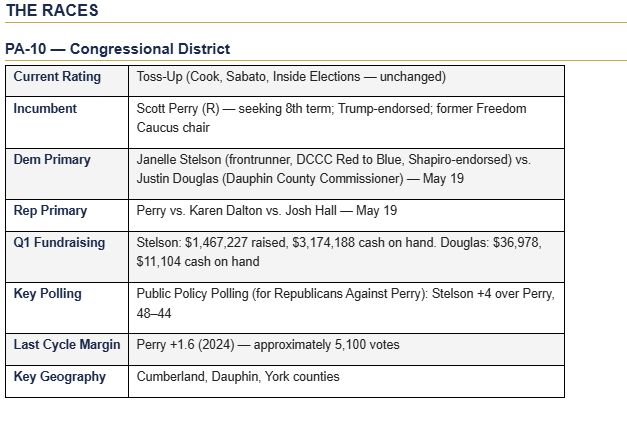
State of the Race
The Democratic primary has developed friction without changing its outcome. Stelson enters May 19 with a 40-to-1 fundraising advantage over Justin Douglas, the full endorsement infrastructure of the party, and 30 years of name recognition across every county in the district. Most independent analysts rate her the prohibitive frontrunner.
The friction is real and worth documenting. Stelson declined multiple debate invitations from Douglas and from local television stations, operating on the assumption the primary is decided. Douglas, in turn, has declined to commit to endorsing her if she wins unless she moves her immigration positions. He has drawn endorsements from CASA in Action, One Pennsylvania, and the Asian Pacific Islanders Political Alliance — organizations representing immigrant and minority communities in Dauphin County that represent exactly the coalition Stelson needs to turn out in November. A contested primary that ends with an unresolved endorsement gap and an immigration message that Perry's campaign can use is a manageable problem. It is not a zero-cost outcome.
Perry is not coasting. A Public Policy Polling survey commissioned by Republicans Against Perry shows Stelson leading Perry 48 to 44 — a four-point margin in a district Trump carried by five in 2024. That is a real number with real source limitations. PPP is a partisan pollster. Republicans Against Perry is an advocacy organization. The directional signal — Stelson leading Perry before the general election has started — is consistent with the broader Pennsylvania environment. The specific four-point margin should be read with appropriate skepticism.
Perry's vulnerability structure has not changed. He cast the deciding vote for the largest Medicaid cuts in history. He was the only vulnerable Republican in the Pennsylvania delegation to vote against extending ACA subsidies. The OBBBA has cut food assistance for 144,000 Pennsylvania families. The district contains 20,000 people who will lose federally assisted healthcare coverage under the same legislation Perry supported. These are not abstractions. They are constituents.
Primary Watch List — May 19
• Stelson margin over Douglas: A clean double-digit win signals unified party infrastructure. A narrow win below 60 percent signals a coalition problem.
• Douglas endorsement decision: Whether he commits to Stelson in the days following the primary is the most important post-primary intelligence signal in the portfolio.
• Perry primary result: Perry's margin over Dalton and Hall indicates his base strength going into the general. A competitive primary on his side would be an additional signal of vulnerability.
The accountability frame: Scott Perry voted to cut Medicaid for 20,000 people in his own district. He voted to strip food assistance from families across Central Pennsylvania. He was the deciding vote. That is the sentence. Everything else is detail.
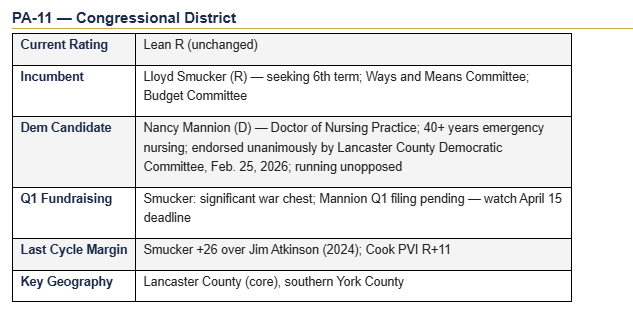
State of the Race
PA-11 remains a long-game accountability investment, not a 2026 pickup target. Smucker won by 26 points two years ago in a Cook PVI R+11 district. That margin does not close in a single cycle regardless of the national environment.
What makes the race worth running hard is the record Smucker is building from the Ways and Means and Budget Committees. He helped write the Medicaid and SNAP cuts. He voted against certifying Pennsylvania's electoral votes on January 6. He voted against Medicare drug price negotiation in a district where seniors turn out at 68 percent. Every vote he takes in this Congress is a public document. Candidates in 2028 and 2030 will use those votes. Nancy Mannion is generating the record now.
Mannion's professional background as a registered nurse with a Doctor of Nursing Practice and director-level experience at Children's Hospital of Philadelphia and Pinnacle Health gives her credible, clinical standing on Smucker's Medicaid votes that no political framing can replicate. When a nurse with 40 years of emergency experience explains what Medicaid cuts mean for Lancaster County families, it lands differently than a campaign advertisement.
Watch List — May
• Q1 FEC filing: The fundraising gap between Smucker and Mannion is the primary structural constraint on the campaign's reach. The April 15 filing reveals the baseline.
• Smucker constituent access: Documentation of town hall frequency and public availability is a legitimate earned media angle in a district with this margin.
• Coordination with HD-97 and HD-41: Mannion's campaign is the top-of-ticket Democratic presence in Lancaster County. Joint voter contact with Branas and Chambers before June is the most consequential decision the three campaigns can make together.
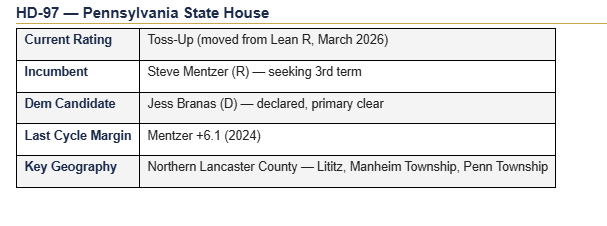
State of the Race
HD-97 has moved to Toss-Up and has not moved back. Two dynamics drove that shift and both remain active in May. First, utility rate pressures from the FPL-model rate increase fight are landing in Lancaster County households — elevated energy costs are no longer a future threat but a present budget item for families in this district. Mentzer has been publicly silent on utility costs. Branas has engaged the issue directly. Second, ICE enforcement activity in Manheim Township has produced visible community disruption in a district where the Latino population has grown significantly over the past decade. Mentzer has no record to run on for either issue.
Mentzer's connection to the Perry-Smucker federal Republican network ties him to a brand that is running 17 points underwater in Pennsylvania. His abortion rights record and his support for school voucher policies that redirect public school funding are Tier 1 accountability targets — documented, sourced, and ready to deploy. His votes in support of OBBBA Medicaid and SNAP provisions are the developing frame as implementation moves forward through the summer and fall.
Branas is a credible challenger with a background as a foreign language educator, former Upper Darby Township councilwoman, and district director for a state representative. Her primary exposure at this stage is name recognition in the new district, which is typical for a state house challenger and moves with earned media exposure. The 2026 environment gives her more legitimate earned media opportunities than any challenger has had in this district in years.
Vulnerability Profile — Tiered
Tier 1 — Documented, sourced, deployable:
• Voted against utility affordability measures in the House Consumer Affairs Committee. Roll call on record.
• Accepted contributions from utility company PACs, 2018–2024. FEC and PECF records confirmed.
• Abortion rights record: voted against reproductive rights protections in multiple sessions. On the public record.
• School voucher support: voted for legislation diverting public school funding to private institutions. Lancaster County public school budgets affected.
• No documented public town hall since 2024. Constituent access on record.
Tier 2 — Documented, requires one additional sourcing step:
• OBBBA Medicaid and SNAP votes — developing frame as implementation moves through 2026.
• ICE coordination and community safety record — requires additional documentation before deployment.
Watch List — May
• Branas Q1 FEC filing, April 15: First fundraising benchmark. The gap with Mentzer determines ad window timing.
• Utility rate developments: Any PUC action on rate increases in the region is a ready-made closing argument. Mentzer's silence becomes the story.
• Coordination with Mannion and Chambers: Joint canvassing infrastructure across HD-97, HD-41, and PA-11 is the highest-value organizing play in the Lancaster portfolio.
State of the Race
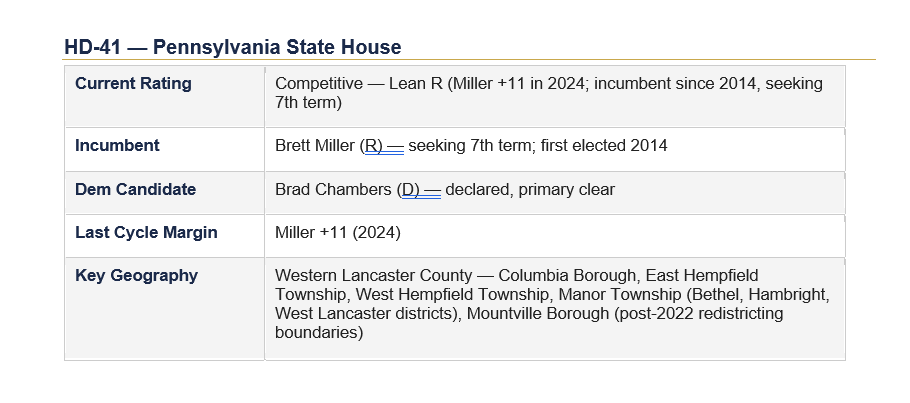
Brett Miller has held HD-41 since 2014 — six consecutive terms. His 2024 margin was approximately 11 points. He holds the district on name recognition and incumbent advantage, not policy positioning. His voting record is conservative and increasingly disconnected from district demographics as southern Lancaster County has shifted over the past decade.
Brad Chambers enters the general with a clean launch: unanimous Lancaster County Democratic Committee endorsement in February, no primary challenge, and a campaign that began organizing in earnest while Miller is still running on the assumption of structural safety. The 2026 environment is the most favorable for a Democratic challenger in HD-41 since Miller first won the seat.
Miller's record on education funding, reproductive rights, and healthcare access is the accountability core. The message discipline required is identical across every race in this portfolio: named votes, specific consequences, no fog. Miller has served seven terms without being seriously tested. He has not been required to defend his record in a high-attention environment. That changes in 2026.
Risk Factors
• Complacency: Lean R means this district is winnable but not won. Miller's 2024 margin of approximately 11 points reflects a structurally Republican district. The path for Chambers runs through the favorable national environment and a disciplined accountability campaign.
• Turnout model: If PA-10 and PA-11 underperform in overlapping precincts, Chambers loses the natural lift from a strong congressional race. Coordination with the full Lancaster portfolio is the mitigation.
Watch List — May
• Chambers Q1 FEC filing: Fundraising viability signals are the primary indicator at this stage.
• Miller public events: If he begins holding visible town halls or community events in May or June, he is signaling internal polling concern. Watch his public calendar.
• Labor endorsements: Education and labor group endorsements before June signal organized institutional infrastructure coming online for the fall.
State of the Race
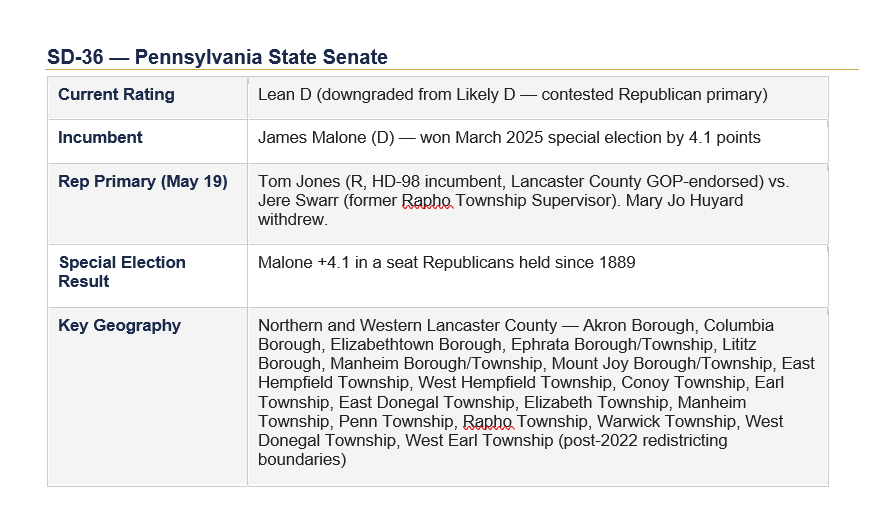
SD-36 is proof of concept — and now it is a test. Malone won a seat Republicans held for 136 years in March 2025. The rating holds at Lean D, but the threat profile has changed materially since March. The Lancaster County Republican Committee has endorsed State Representative Tom Jones (HD-98) to reclaim the seat. Jones is a sitting incumbent with a voter file, legislative experience, and the full organizational backing of the county party. Jere Swarr, a former Rapho Township Supervisor, is his primary opponent. The Republican primary on May 19 resolves which threat Malone faces in the general.
Jones is the heavier lift. He brings resources, name recognition across overlapping geography, and a Republican apparatus that views this seat as an institutional loss requiring correction. Malone's 4.1-point special election margin was built on a turnout model more favorable to Democrats than the November general electorate will produce. That gap is the central vulnerability. It is not fatal — Malone has governed with visible local presence and has built genuine incumbent credibility — but it is real and requires a fully resourced general election campaign, not a maintenance operation.
Swarr is a credible figure in rural Lancaster County. Former Rapho Township Supervisor is a legitimate local credential. He is running without the county committee endorsement against an incumbent state representative. A Swarr upset on May 19 would represent a different but still serious threat — one without Jones's organizational infrastructure but potentially more difficult to define in the general campaign.
HD-98: Secondary Opportunity
If Jones wins the May 19 primary and moves to the SD-36 general election race, he vacates his HD-98 state house seat. That creates an open-seat opportunity in a district that has not been seriously contested. The Public Signal Institute is flagging HD-98 as an active watch item pending the May 19 result. Democratic candidate recruitment in HD-98 should begin no later than the week following the primary if Jones advances.