
A Familiar Wound
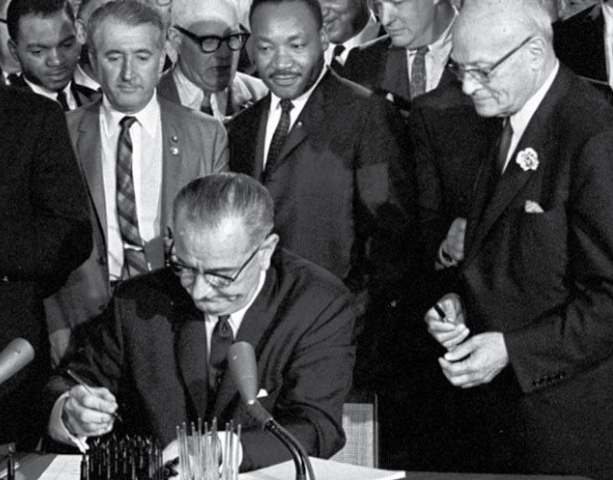
President Johnson signing the 1965 Voting Rights Bill
Between the world we were promised and the world we now inherit lies a familiar wound. We have been here before — standing at the edge of progress, watching it recede. But this time, they have come for the ballot itself.
My mother was born in 1954. She and every other African American of her generation was born disenfranchised. Eleven years later, the Voting Rights Act was passed. And for the first time in the history of the United States, this land of the free could truly call itself a democracy. It had been a fight to get there.
A land of contradictions and cruelty is our foundation. A land made home for white male property owners. And as we make sense of what is happening in this country, history tells us that this is a long and vicious fight. Make no mistake — a Black underclass pinned beneath a racial caste system is not new in America. It has never left. It has only been renamed. It is quite literally the color line that we still have no answer for. Or rather, a question that white Americans remain too comfortable accepting.
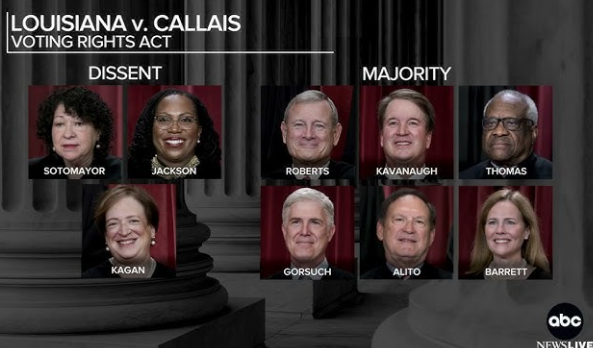
We were a true democracy starting August 6th, 1965. On April 30th, 2026, the Supreme Court of the United States issued its ruling in Louisiana v. Callais — a 6-3 decision that, while not formally striking down the Voting Rights Act, rendered its core protections effectively dead. Justice Kagan said it plainly in her dissent: the majority had completed the demolition. That democracy died on April 30th, 2026.
What comes next? State violence. Legislative violence. Institutional violence aimed directly at Black people. Laws that incarcerate us at rates that defy accident. Policies that strip us of political representation. A criminal legal system engineered to justify our harm. This is not speculation. This is the American pattern.
Where have you been — white progressives, liberals, allies? This is the law of the land now. The ballot — the one tool a democracy gives its people to dismantle itself from within — has been gutted. And you have been quiet.
We know why. The violence against Black people in this country has been so normalized that there is a threshold for your outrage. Economic violence does not trend. Political disenfranchisement does not go viral. Psychological violence leaves no visible wound. It has to be on camera. There has to be a knee on a neck before you take to the streets. If it does not fit the TikTok schema, it does not move you.
But hear this: a people rendered voiceless by law are a people being prepared for something worse. Your silence is not neutrality. It is permission. And this country is showing us, once again, that we must be bloodied before we are taken seriously.
They have miscalculated before. Every system built to break us has met the same result — a people who refused to be broken.
Frederick Douglass did not wait for America to be ready. He made himself free, then made the case for freedom so clearly that the nation could not ignore it. That is our inheritance. Not patience. Not petition. Defiant, determined survival.
Vulnerable does not mean helpless. There are a few things that cannot be taken from us.
Our culture: In a time like this, it will take the artist to deliver the commentary of our era.
Our spirit: Emancipation came once. Progress came before. With a fight, this too shall pass.
Our love: Our love will warm, guide, and nourish us through this time.
Our education: Through collective education we can uplift and embrace a new social and political consciousness. Through this, there is a path of resistance.
Collective survival looks like rooms full of people who have decided that their liberation is a shared project. It looks like neighbors becoming organizers. It looks like political education replacing political apathy. It looks like power — built slowly, deliberately, from the ground up.
I am not speaking in abstractions. In Lancaster, Pennsylvania, we are already doing this work. Bobby’s Living Room brings together artists and organizers to build Black cultural and political consciousness. This summer, we are bringing education directly to Black children. These are not programs. They are acts of survival.
What will African Americans do to get through this time? What we do best. Survive. We owe it to each other to not be reactionary — but to survive first. Collectively. The time for working as individuals or fractured units has passed.
