
The HorseRace| Public Edition| March 2026
A recurring structural briefing on the forces shaping competitive elections.
Structure Drives. Attention Decides.
Executive Frame
Elections are shaped by structure and decided by attention.
This memo measures both.
Monthly Indicator
Structural Environment: Favors Democrats
Volatility Level: High
Attention Advantage: Republicans (volume), Democrats (alignment)
Executive Summary
The 2026 midterm environment structurally favors Democrats. That advantage is conditional.
Escalating tensions involving Iran, oil instability, and sustained cost-of-living pressure define a high-volatility moment.
Military conflicts carry profound human consequences and demand seriousness and respect. They are not political abstractions. Geopolitical events, however, reshape economic conditions and redirect voter attention.
Two forces govern this cycle:
Elasticity — how persuadable a district is.
Volatility — how quickly events reorder attention.
Elastic districts shift when volatility rises.
The central question: where does voter attention settle?
Metrics Guide

The attention economy is the idea that human attention is limited and valuable, so media platforms, advertisers, and creators compete to capture and keep it.
In simple terms: attention is treated like currency—the longer they keep you watching, clicking, or scrolling, the more value they gain.
Attention Economy Index (AEI) — narrative control, not polling margin.
30s = disadvantage
40s = competitive
50s = advantage
60+ = dominance
Elasticity — district responsiveness.
30s = stable
40s = mildly elastic
50s = swing terrain
60+ = highly responsive
Volatility: Low / Moderate / High
Current: High

Anti-war activist protest in front of the White House in Washington, DC, on January 4, 2020.
Andrew Caballero-Rerynolds/AFP via Getty Images
National Environment
Escalation involving Iran has heightened geopolitical uncertainty.
A prolonged conflict raises energy prices and deepens household strain.
If foreign policy dominates attention, Republicans consolidate.
If affordability dominates attention, structural midterm pressure asserts itself.
Republicans control volume.
Democrats hold cost-of-living credibility.
Volume moves headlines.
Alignment moves voters.
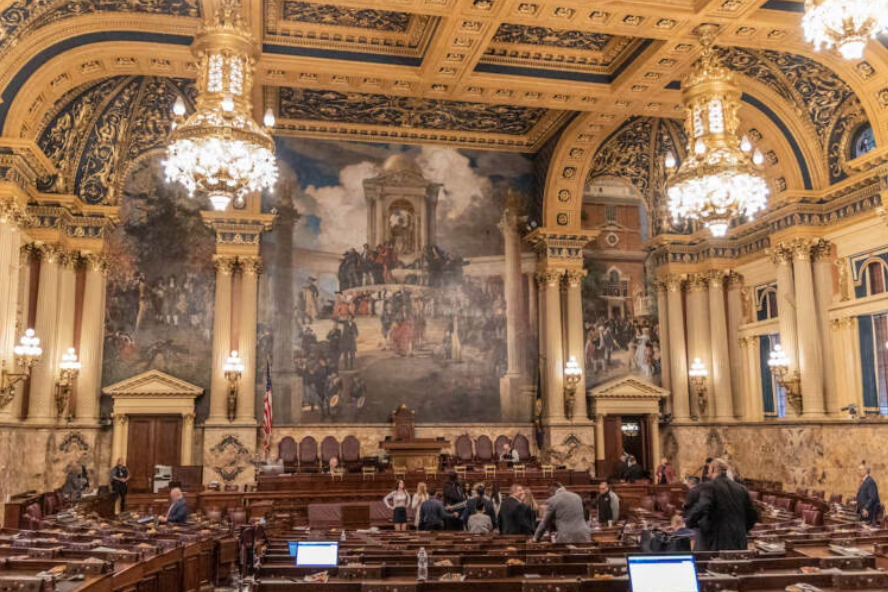
PA State House Floor
Pennsylvania Overview
Rate increases from PECO, owned by Exelon, have sharpened affordability concerns statewide.
Economic salience is elevated. In elastic terrain, that matters.

Janelle Stelson (left), Scott Perry (right)
PA-10
Janelle Stelson
Scott Perry
Elasticity: 58
AEI: 52
Rating: Lean Republican, Competitive
Highly responsive suburban terrain. Sustained economic focus keeps this race within reach.

Lancaster County
Lancaster is competitive terrain.

Brad Chamber (Left), Rep. Brett Miller (Right)
PA House District 41
Brad Chambers
Brett Miller
Elasticity: 55
AEI: 49
Rating: Lean Republican
Suburban persuasion and turnout determine movement.

Tom Jones (Left), Senator James Malone (right)
PA Senate District-36
James Malone
Tom Jones
Elasticity: 46
AEI: 47
Rating: Lean Republican
Less elastic terrain. Movement requires scale.

Jess Branas (Left), Rep. Steven Mentzer (Right)
PA House District-97
Jess Branas
Rep Steven Mentzer
Elasticity: 50
AEI: 48
Rating: Toss-Up
Margins decide control.
HorseRace Movement Zones
Economic Shock
Energy or utility spikes intensify affordability pressure and accelerate suburban drift.
War-Dominant Attention
Foreign policy focus consolidates Republican alignment.
Affordability Stabilization
Sustained cost-of-living focus activates structural midterm gravity.
Monthly Attention Assessment
Republicans lead volume.
Democrats lead alignment.
In elastic districts, alignment outlasts volume.
Structural Rule
Attention determines direction.
Elasticity determines distance.
Volatility determines speed.
Elections move when these forces align.
The Race is On.
— The September Group