
SEPTEMBER 2026 HORSERACE REPORT
September Introduction
Forty two days to November 3. The environment has not shifted in direction since August — it has accelerated. Trump's approval hit a new second-term low of 33 percent in Reuters/Ipsos and 32 percent in the University of Massachusetts (UMass) Amherst survey in late August, as the Iran war nears its six-month mark and two Lancaster County residents die in Pennsylvania's largest measles outbreak in three decades. The deaths have produced a national clash between Governor Josh Shapiro and Health and Human Services (HHS) Secretary Robert F. Kennedy Jr. that has made Lancaster County the epicenter of a public health accountability argument running directly into the November election. Data center-driven electricity rate increases — up 14.6 percent in Pennsylvania over the past year, up 20.6 percent since 2024 — have become what the Capital-Star calls 'the defining issue of the state's 2026 elections.' Both issues land on the voting records and public postures of Scott Perry and every Republican in the PSI portfolio.
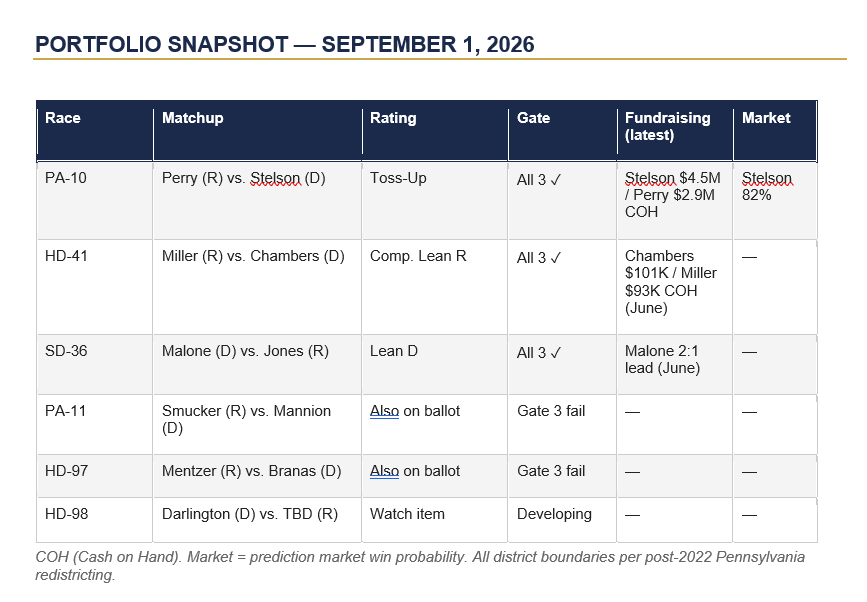
This edition applies the three-gate framework. Gate 1: competitive viability. Gate 2: power impact. Gate 3: attention return. Three races receive full coverage: PA-10, HD-41, and SD-36. Two are noted as also on the ballot: PA-11 and HD-97. HD-98 remains a watch item. The national environment and two Pennsylvania-specific issues — measles and data centers — are integrated into the race analysis, not siloed as separate sections.
The National Environment
Presidential Approval
Trump's approval has settled at 32 to 33 percent across the most current major surveys — a Reuters/Ipsos poll covering late August found 33 percent approval and 65 percent disapproval, a 14-point slide from the 47 percent he held at the start of his second term and a 4-point drop from a month prior. The UMass Amherst survey found 32 percent approval. Silver Bulletin's weighted aggregate, updated September 1, shows a net approval of -19.5 — slightly recovered from the all-time low of -20.6 set July 30 but still far below his first-term performance at this point (-11.6 net at a comparable stage). Independent approval stands at 34 percent — below the 36 percent level that preceded Democrats' 41-seat wave in 2018.
Within his own party, Republican approval of Trump fell from 85 percent in Quinnipiac's June 24 survey to 76 percent in July 27. Only 19 percent of Republicans say they are enthusiastic about the rest of his second term, down from 38 percent in the spring. The RNC (Republican National Committee) spokesperson's talking point — 'Republicans are united, on offense, and armed with our largest war chest in party history' — contradicts AFP Action (Americans for Prosperity Action) executive director Nathan Nascimento's documented finding that one in five reliable Republican base voters is either planning to stay home or considering voting for Democrats.
The Iran War
The Iran war has entered its sixth month and has not improved politically for the administration. Quinnipiac found 66 percent of voters say the war has not been worth fighting, 74 percent oppose sending ground troops, and only 28 percent approve of Trump's handling of the Iran situation. Reuters/Ipsos (July 24–26) found only one-third of voters support the war and 69 percent say Trump has not clearly explained its objectives. Among independents, Democratic congressional candidates were favored 36 to 20 percent in the Reuters/Ipsos survey. Senator Thom Tillis called the war 'an additional political drag' in late July. Scott Perry voted for the budgets that funded that war posture and has been publicly silent on its human cost. His silence is documented. It is deployable.
House and Senate Control
Republicans hold a 220-215 House majority. Democrats need a net gain of 3 seats for a majority. Inside Elections confirms the current seat count. The competitive map has expanded in August: Cook Political Report moved FL-14 and MI-10 from Lean Republican to Toss-Up on August 25; Sabato's Crystal Ball moved TX-15 from Lean Republican to Toss-Up on August 26. Prediction markets give Democrats an 84 percent probability of taking the House. PA-10 remains one of the Republican-held Toss-Up seats on the path to a Democratic majority.
On the Senate map, Cook moved Iowa and Texas from Lean Republican to Toss-Up on August 20 — two states that were not on the competitive radar six months ago. Democrats need a net gain of 4 to retake the Senate majority. The map is expanding in Democrats' direction in both chambers simultaneously.
The Generic Ballot and Enthusiasm
Silver Bulletin's generic ballot aggregate shows Democrats leading by approximately 6 points. The Washington Post/Ipsos poll found Democrats hold a 10-point advantage among voters who say they are absolutely certain to vote in November. Change Research found Democratic vote motivation running 13 points above Republican motivation — 88 percent to 75 percent. The MAGA (Make America Great Again) media ecosystem that amplified Republican base turnout in 2024 has collapsed: Dan Bongino's audience is at half his 2024 peak, the Daily Wire's YouTube audience is down nearly 90 percent from its 2023 high, and Candace Owens's viewership dropped from 16 million weekly views to 4.1 million per a New York Times analysis published July 31.
Pennsylvania: Two Issues That Changed in August
The Measles Crisis — Lancaster County at the Epicenter
On August 25, the Pennsylvania Department of Health (DOH) confirmed two measles-associated deaths in Lancaster County — the state's first in 35 years and the first reported in the United States in 2026. One of the two deceased was a newborn. As of September 1, Pennsylvania has reported 497 measles cases in 2026, with 87 hospitalizations. Half of Pennsylvania's counties have reported at least one case. All were in unvaccinated residents. The outbreak is concentrated in Lancaster County, where MMR (measles, mumps, and rubella) vaccination coverage among kindergartners fell to 87.6 percent in the 2025–26 school year from 95.5 percent in 2017 — well below the 95 percent threshold public health authorities target to prevent sustained transmission. At Ephrata Mennonite School in Lancaster County, fewer than half of kindergartners were immunized last year.
What made this a political event of the first order is what happened next. Governor Shapiro held a press conference at Lancaster County, criticized HHS Secretary Robert F. Kennedy Jr. for pushing vaccine misinformation, and directly linked Kennedy's rhetoric to the deaths. Kennedy responded on X, promoting a debunked claim that the MMR vaccine contains fetal tissue and suggesting Shapiro may have 'fabricated' the deaths. The CDC then omitted the two deaths from its national tally, citing insufficient information, while the CDC's official X account endorsed Kennedy's skepticism. Lancaster County Commission Vice-Chair Josh Parsons posted dozens of X messages disputing that the deaths were from measles. The Pennsylvania DOH pushed back, affirming its classification.
City and State Pennsylvania's September 1 analysis noted that Shapiro's administration has come under fire from some public health experts for an initial lack of transparency about the deaths — a critique that complicates the accountability frame. The state initially declined to share information about the deaths citing privacy concerns before reversing course. That reversal gave Kennedy and his allies an opening that would not have existed had the state communicated clearly from the outset.
The accountability argument: Trump's administration cut nearly 10 percent of the CDC workforce and eliminated half of its disease intelligence officers. Kennedy promoted vaccine misinformation. Lancaster County MMR vaccination fell from 95.5 to 87.6 percent. Two residents died. One was a newborn. Scott Perry has not said a word.
The measles crisis is directly relevant to every PSI (Public Signal Institute) portfolio race. Perry's silence on Kennedy's misinformation and on the CDC's manipulation of the death count is a documented accountability gap. In SD-36, the affected communities — Ephrata, Lititz, Manheim Township, and the Mennonite and Amish-adjacent school districts where vaccination rates have collapsed — are inside the district's geography. In HD-41, the Hempfield School District is in the district. In every race, the argument is the same: Republican governance produced the conditions, Republican misinformation sustained them, and Republican candidates have said nothing.
Data Centers — The Issue That Hit the Ballot Box
Pennsylvania's residential electricity rates rose 14.6 percent in the past year, 18.9 percent in 2025 alone according to federal Energy Information Administration (EIA) data, and are up more than 50 percent compared to 2020. A record 387,000 Pennsylvania households faced utility shutoffs in 2025. The primary driver identified in the Kleinman Energy Center's August analysis: data center-driven demand increases in the PJM (Pennsylvania-New Jersey-Maryland Interconnection) regional grid, where data center capacity charges have totaled $29.4 billion in the last four capacity auctions — nearly half of all capacity charges incurred.
Pennsylvania has 81 to 101 active data center development proposals, depending on the source cited. The Pennsylvania House of Representatives passed House Bill (HB) 1834 on March 24 by a 104-95 vote — the Data Center Ratepayer Protection Act, requiring the Public Utility Commission (PUC) to develop regulations preventing data center infrastructure costs from being passed to residential ratepayers. The Pennsylvania Senate has not acted on HB 1834. Pennsylvania lawmakers left in place a sales tax exemption for data centers projected to cost the state $2 billion in tax revenue by mid-2031, despite bipartisan voter anger. The only data center measure enacted in the 2026 budget cycle requires disclosure of energy and water usage by data centers consuming more than 10 megawatts annually.
Capital and Main's August 6 reporting documented that voters in Archbald (Lackawanna County) and across Pennsylvania have made electricity bills a defining campaign issue. Rallies have targeted Governor Shapiro specifically over his administration's approach to data center expansion. A 2026 Politico national survey found nearly half of Americans expect data center energy costs to be a campaign issue. A Pew Research Center poll found 38 percent of voters say the data center impact on home energy costs has been mostly bad.
The Lancaster application: Steve Mentzer (HD-97) accepted utility company PAC contributions from 2018 to 2024. Brett Miller (HD-41) has not addressed data center rate impacts publicly. Scott Perry has been silent on HB 1834 and on the federal regulatory framework governing PJM grid costs. Lloyd Smucker (PA-11) sits on Ways and Means and has said nothing about the $2 billion data center tax exemption that Pennsylvania ratepayers are financing. Every one of these positions is documented, sourceable, and deployable
State of the Race — September
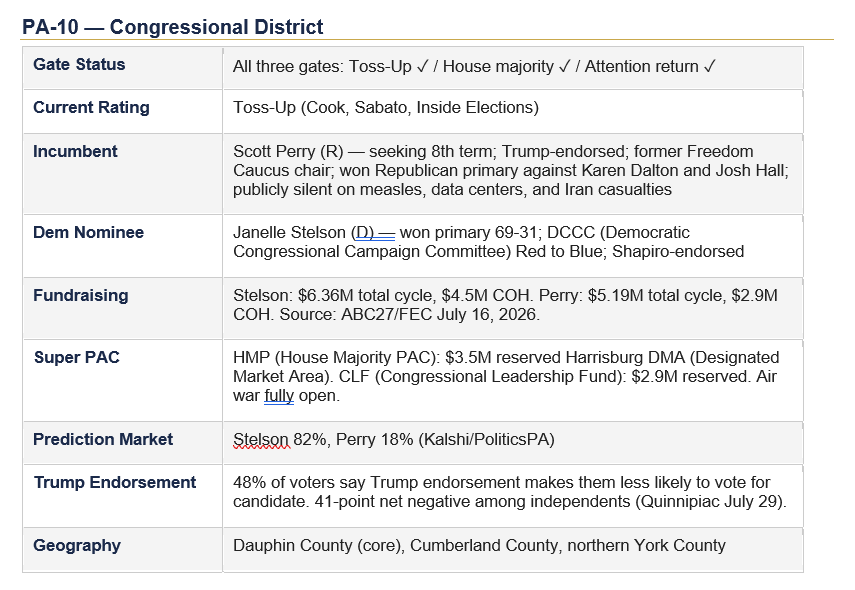
Stelson enters September with the strongest Democratic position in PA-10's competitive history: $4.5 million cash on hand, a $1.6 million advantage over Perry, 82 percent prediction market probability, and a national environment running 14 points below Trump's starting approval. The race has not been polled publicly since the general election began, but every structural indicator has moved in Stelson's direction since the primary. The most expensive congressional race in Pennsylvania — $11.5 million raised combined — is fully engaged on both sides.
Perry is not without resources or resilience. He has won this seat seven times. The CLF's $2.9 million Harrisburg DMA reservation, now legally coordinated without ceiling with Perry's campaign following the Supreme Court's removal of coordinated spending limits, means the Republican resource base surrounding his campaign is substantially larger than his own committee's $2.9 million COH figure suggests. The first candidate to define the air war frame in the Harrisburg DMA often holds it through November. Watch CLF's opening advertising for whether Perry runs on his record or on Stelson's character.
The measles crisis lands specifically on Perry. Lancaster County, where the two deaths occurred and where vaccination rates have collapsed below safe thresholds, is within driving distance of Perry's core Dauphin County constituency. Perry's public silence on Kennedy's misinformation — a fellow Republican appointee whose rhetoric contributed to the vaccination collapse — is a documented, confirmable position. The Stelson campaign's decision about whether and when to deploy the measles accountability frame is among the most significant message choices of the fall campaign.
The Douglas coalition question has been resolved. On approximately August 25, 2026, Douglas endorsed Stelson via Facebook, writing: “Janelle Stelson and I competed against one another in the Democratic primary. We did not align on everything then, and we do not align on everything today… I believe she will be a partner I can work with for the betterment of Dauphin County and the broader PA-10 community.” This is workable-partner framing, not enthusiastic coalition activation. The CASA In Action, One Pennsylvania, and APIA PA (Asian Pacific Islander Political Alliance) networks Douglas activated require direct Stelson campaign outreach to fully transfer — the endorsement creates the permission structure but does not automatically move those voters. The Dauphin County Democratic Committee (DCDC) transition under chair Ciera Dent, now two months in, is the organizational test running parallel to the air war.
Measles and Data Centers — PA-10 Applications
• Measles: Perry's silence on Kennedy's misinformation is documented. His silence on the CDC's removal of the Lancaster County deaths from the national tally is documented. Both are deployable without requiring Stelson to make an affirmative claim about causation that the CDC has disputed.
• Data centers: Pennsylvania electricity up 14.6% in the past year. 387,000 households faced utility shutoffs in 2025. Perry has not spoken publicly on HB 1834, on the PJM (Pennsylvania-New Jersey-Maryland Interconnection) capacity charge structure, or on the federal regulatory framework that governs grid costs. His silence on household electricity bills is the accountability gap.
Watch List — September
• Douglas endorsement: Confirmed. On approximately August 25, 2026, Douglas endorsed Stelson via Facebook, stating: “Janelle Stelson and I competed against one another in the Democratic primary. We did not align on everything then, and we do not align on everything today… I believe she will be a partner I can work with for the betterment of Dauphin County and the broader PA-10 community.” The endorsement is workable-partner framing, not enthusiastic coalition activation. The CASA In Action, One Pennsylvania, and APIA PA (Asian Pacific Islander Political Alliance) networks Douglas activated require direct Stelson campaign outreach to fully transfer — the endorsement creates the permission structure but does not automatically move those voters.
• CLF first ad content: The frame CLF establishes in its first Harrisburg DMA broadcast — Perry's record or Stelson's character — defines the general election opening.
• Shapiro measles press conference fallout: City and State PA's transparency critique of Shapiro's initial handling of the deaths creates a split-screen risk. If the criticism of Shapiro's communication deepens, Perry's campaign will attempt to use it to muddy the public health accountability frame. Watch whether Shapiro corrects the transparency deficit before Perry's campaign deploys it.
• October 15 FEC filing: The decisive financial intelligence window. FEC (Federal Election Commission) FEC (Federal Election Commission) Q3 fundraising reveals whether Stelson has sustained her cash advantage through the summer and whether Perry has closed the gap.
The sentence: Scott Perry voted to cut Medicaid for 3 million Pennsylvanians, voted to strip food assistance from 144,000 families, called his opponent a racist on primary night, and has said nothing while Lancaster County residents died and the administration he supports erased their deaths from the federal record.
State of the Race — September
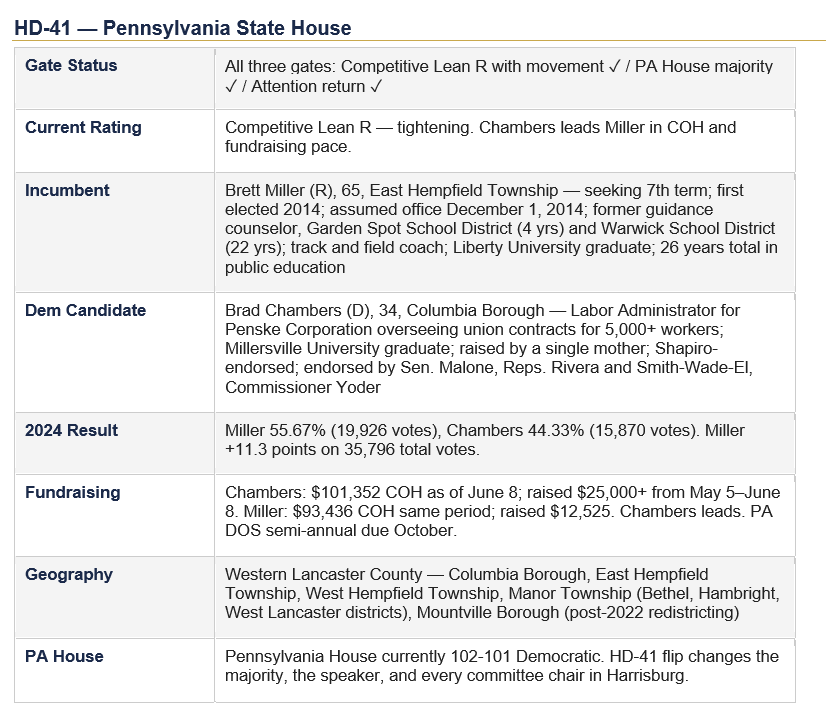
Miller won HD-41 in 2024 by 11.3 points — a structurally Republican result in a district where Republicans hold 46 percent of registered voters against 35 percent Democratic. That registration gap is the structural reality Chambers must overcome. What is different in September 2026: Chambers is outpacing Miller in fundraising pace and cash on hand; Governor Shapiro has endorsed Chambers; the national environment has Democratic enthusiasm running 13 points above Republican motivation; and LCDC (Lancaster County Democratic Committee) chair Michael Mezzetti's home district is East Hempfield Township, the geographic core of HD-41.
A critical correction to prior PSI analysis: Chambers is not an educator. He is a Labor Administrator for Penske Corporation overseeing union contracts for more than 5,000 workers. Miller is the educator — he spent 26 years as a guidance counselor across two Lancaster County school districts — four years at Garden Spot School District and 22 years at Warwick School District, where he also coached track and field in East Hempfield Township before entering politics. This correction changes the biographical contrast entirely. The contrast is not occupational. It is legislative and economic. Miller's voting record on education funding, healthcare access, housing, and utility affordability runs against the working-class interests Chambers's biography represents. Chambers's union background and his advocacy for 'fair funding for our public schools, affordable housing, and universal healthcare' is the economic justice frame. Miller's record is the accountability target.
Miller has not been required to publicly defend his record in a high-attention environment during any of his six prior terms. His 2024 opponent was a first-time challenger without Shapiro's endorsement, without union institutional support, and with comparable but not superior fundraising. In 2026, every one of those variables has changed.
Data Centers and Measles — HD-41 Applications
• Data centers: Miller sits on the Consumer Protection, Technology, Utilities and Insurance Committee — the Pennsylvania House committee with direct jurisdiction over utility rate regulation. His silence on HB 1834, on data center ratepayer protections, and on the PJM (Pennsylvania-New Jersey-Maryland Interconnection) capacity charges that have driven Lancaster County residential electricity bills up more than 20 percent since 2024 is not ordinary silence. It is silence from the committee seat assigned to address exactly these issues. Hempfield School District families and East Hempfield Township households are paying those bills. That is a documentable and deployable accountability position.
• Measles: The Hempfield School District serves communities overlapping the HD-41 geography. Lancaster County vaccination rates have declined sharply. Miller has not spoken publicly on the measles outbreak, on Kennedy's misinformation, or on the CDC's handling of the Lancaster County deaths. His silence mirrors Perry's.
Watch List — September
• Mezzetti-Chambers joint organizing: September canvassing volume in East Hempfield and Columbia Borough precincts is the first test of the LCDC grassroots model at general election scale.
• Miller public calendar: Any visible community events in September signal internal polling concern. His absence since the primary is itself a data point.
• HDCC (Pennsylvania House Democratic Campaign Committee) engagement: Whether the HDCC (Pennsylvania House Democratic Campaign Committee) activates resources for HD-41 before October determines the advertising window available to Chambers.
• October PA DOS filing: The semi-annual state filing is the last public financial data on both campaigns before November 3. Chambers maintaining or expanding his COH advantage is the primary financial indicator.
State of the Race — September
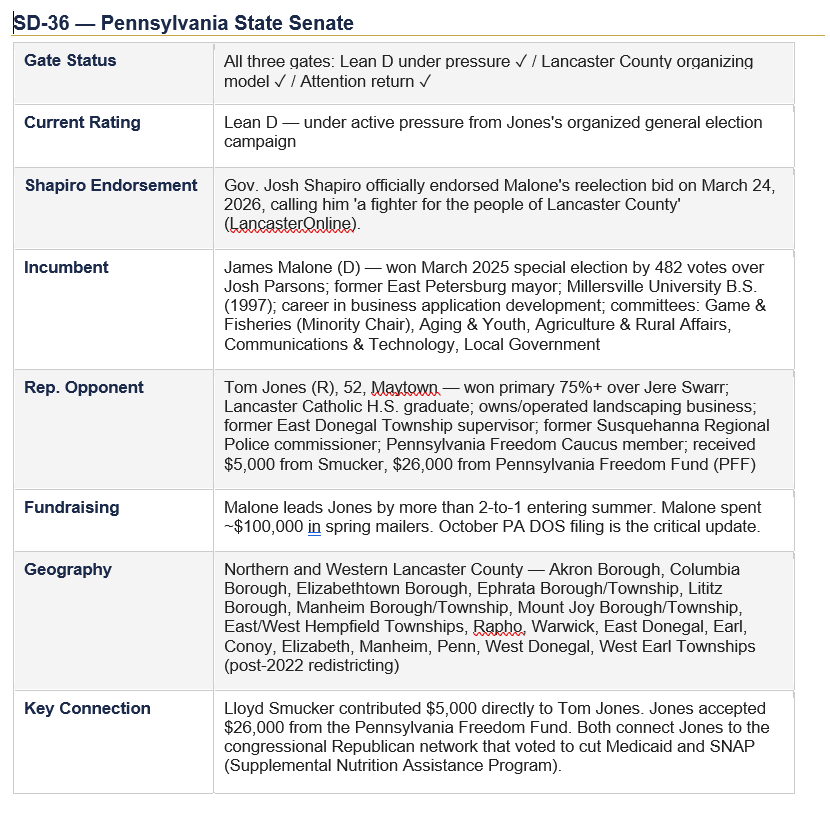
SD-36 is the race that proves or disproves the Lancaster County Democratic organizing thesis. Malone holds a seat Republicans held for 136 years, won by 482 votes in March 2025 in a district where SD-36 voted for Trump by 15 points in 2024. Tom Jones enters the general with the most credentialed Republican profile Malone has faced: a sitting state representative with an existing voter file across overlapping geography, full Lancaster County Republican Committee institutional support, Freedom Caucus network backing, and Smucker's financial imprimatur.
Jones's Freedom Caucus membership is the accountability frame that connects him most directly to the national Republican agenda. The Pennsylvania Freedom Caucus has 'focused on spending cuts and supporting bills to save women's sports from transgender athletes and to block any state funds for universities or hospital systems that provide gender-affirming care,' per LancasterOnline's primary-night profile. Jones ran on parents' rights, school choice, energy sector deregulation, and what he called defending 'God-given freedoms and enduring American values.' That platform is designed for a Republican primary. The general election in a Lean D district requires him to either defend that platform to a broader electorate or pivot, and any pivot is documentable.
Malone's structural assets are real and have grown since the special election. He leads Jones by more than 2-to-1 in available funds. He has governed with visible local presence — constituent services, legislative work on utility costs, small business access. His committee assignments — Game & Fisheries, Agriculture & Rural Affairs, Local Government — are precisely calibrated to the rural townships in Rapho, Warwick, Conoy, and East Donegal that Jones's base depends on. The LCDC leadership transition, now in its twelfth week under Michael Mezzetti, is the organizational question PSI cannot answer from public sources.
Measles and Data Centers — SD-36 Applications
• Measles: The deaths occurred in Lancaster County. The epicenter of the outbreak — Ephrata Mennonite School, where fewer than half of kindergartners were vaccinated — is inside SD-36's geography (Ephrata Borough/Township is explicitly in the district). Jones has not spoken publicly on Kennedy's misinformation or on the CDC's removal of the Lancaster County deaths from the national tally. Tom Jones aligned with Josh Parsons, who posted dozens of X messages disputing that the deaths were from measles. Parsons endorsed Jones in the primary. That alignment is documentable.
• Data centers: Electricity rate increases are a constituent-facing economic argument in the agricultural and small-business townships of SD-36. Rapho, Warwick, and East Donegal townships are agricultural communities where electricity costs for farms, cold storage, and small businesses have risen more than 20 percent since 2024. Jones's stated support for 'unleashing PA's energy sector' without accompanying ratepayer protections is a documented policy position. Malone's committee work on Communications & Technology and Local Government gives him standing to engage the issue with constituent credibility.
The Smucker-Jones Frame
The accountability inversion: Tom Jones took $5,000 from the congressman who voted to cut Medicaid for Lancaster County families and $26,000 from the Pennsylvania Freedom Fund. He aligned with the Lancaster County commissioner who spent the week after two residents died posting that there were zero measles deaths in Lancaster County. I'm not the one connected to Washington's agenda. My opponent is.
Watch List — September
• Malone-Mezzetti public joint activity: Any campaign event between the SD-36 incumbent and the new LCDC chair is the first operational confirmation that the June 8 endorsement split has been resolved.
• Jones general election message: Jones won his primary on a Freedom Caucus platform. Watch whether he pivots to local economic concerns in the general — utility costs, agricultural issues in Rapho and Warwick, school budgets — or defends his primary message. The pivot tells you how his internal polling reads the general electorate.
• Parsons alignment: Josh Parsons's public dispute of the measles deaths while serving as Lancaster County Commission Vice-Chair creates an accountability opening. Jones's relationship to Parsons — Parsons was defeated by Malone in the special election and is now the Republican most publicly associated with disputing the deaths — is documentable and deployable.
• October PA DOS filing: Jones's Q2 fundraising total, including Freedom Caucus network contributions and any additional Smucker investment, is the financial intelligence that determines the general election resource gap.
Also on the Ballot
PA-11: Nancy Mannion (D) is the Democratic candidate challenging incumbent Lloyd Smucker (R) in Pennsylvania's 11th Congressional District, which covers Lancaster County and portions of southern York County. Smucker helped write the OBBBA (One Big Beautiful Bill Act) Medicaid and SNAP cuts from Ways and Means. His January 6 vote is on the public record. Campaign infrastructure and fundraising constraints prevent full section coverage in the September through November editions. The full PSI intelligence archive on PA-11 is available for 2028 and 2030 cycle planning.
HD-97: Jess Branas (D) is the Democratic candidate challenging incumbent Steve Mentzer (R) in the 97th State House District, covering southern Lancaster County including Conestoga, East Lampeter, West Lampeter, Pequea, and portions of Manheim and Manor townships (post-2022 redistricting). Mentzer's documented utility PAC contributions, his silence on rate increases, and his absence from public constituent events since 2024 constitute an accountability record. Campaign infrastructure and fundraising constraints prevent full section coverage. The full PSI intelligence archive on HD-97 is available for future cycles.
HD-98 (Watch Item): Hugh Darlington has been confirmed as the Democratic candidate in the open seat race created when Tom Jones vacated HD-98 to run for SD-36. The Republican primary produced Danielle Lindemuth and Nicky Woods. PSI is conducting a full intelligence pull on Darlington. An open seat in a D+6 (Democratic plus six point generic ballot) environment is a developing opportunity.
Analyst Notes — September 2026
The Three-Gate Framework in Operation
PA-11 and HD-97 fail Gate 3 — attention return — on the operational intelligence available to PSI. Both campaigns lack the infrastructure to operationalize additional analysis in the time remaining before November 3. The full PSI intelligence archives on both races are complete, sourced, and ready for use in future cycles. The accountability records PSI has built on Smucker and Mentzer do not expire with the 2026 campaign. They are the foundation for 2028 and 2030.
The Two New Issues
The measles crisis and data center electricity costs entered the September environment simultaneously and reinforce each other's political effect through the same mechanism: both are issues where Republican governance produced the conditions, Republican misinformation or inaction sustained them, and Republican candidates in every PSI (Public Signal Institute) portfolio race have said nothing. The accountability argument writes itself. What it requires is not additional analytical work. It requires campaigns with the infrastructure to deploy it.
Of the three races receiving full coverage, PA-10 has the most immediate deployment capacity for both issues through the Stelson campaign's general election advertising and earned media operation. HD-41 has deployment capacity through the Chambers campaign's volunteer and canvassing infrastructure if the LCDC grassroots model is functioning. SD-36 has deployment capacity through Malone's constituent communication operation and his committee standing on Communications & Technology. The question in each case is not whether the arguments exist — they do, they are documented, and they are powerful. The question is whether the campaign infrastructure can carry them to the voters who need to hear them in 63 days.
The October 15 Intelligence Pull
The most important single date remaining in the 2026 cycle intelligence calendar is October 15. FEC Q3 filings covering July 1 through September 30 and Pennsylvania DOS semi-annual filings covering January through June 2026 arrive simultaneously in the week of October 15. These two filing deadlines will produce the last complete public financial picture of every PSI portfolio race before November 3. PSI will conduct a full portfolio fundraising pull the week of October 15 and publish an update within 48 hours of the filing deadline. The Pre-General FEC filing, due October 22, covers activity through October 14. 48-hour notices for contributions of $1,000 or more begin within 20 days of the election, providing real-time intelligence on last-minute fundraising in the final stretch.
Shapiro as the Structural Variable
Governor Shapiro's reelection campaign remains the structural floor for Democratic performance across every PSI portfolio race. His 60 percent job approval, his confirmed endorsements of Stelson (PA-10), Cognetti (PA-7), Brooks and Harvie (PA-1) in competitive congressional primaries, and his state-level endorsements of Malone (SD-36) and Chambers (HD-41), his 2022 performance in Perry's district, and his direct confrontation with Kennedy over the measles deaths have made him the defining figure in Pennsylvania's 2026 political landscape. His measles press conference in Lancaster County was simultaneously the most aggressive public health accountability action by a Pennsylvania governor in a generation and — per City and State PA's analysis — a communication failure that gave his critics an opening. Both things are true. The net effect on November 3 will be determined by whether his direct confrontation with Kennedy or his transparency deficit defines the story in the Harrisburg and Lancaster media markets between now and Election Day.
PUBLIC SIGNAL INSTITUTE · HORSERACE REPORT · SEPTEMBER 1, 2026
Produced by the Public Signal Institute. All race assessments reflect publicly available information as of September 1, 2026. All district boundaries reflect post-2022 Pennsylvania redistricting maps certified by the Pennsylvania Supreme Court.