HORSERACE REPORT APRIL 2026 PUBLIC EDITION
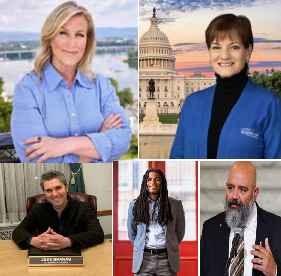
Top left to right: Janelle Stelson, Right; Nancy Mannion
Bottom left to right Jess Branas, Brad Chambers, Sen. James Malone.
THE SEPTEMBER GROUP | POLITICAL INTELLIGENCE
Pennsylvania District Portfolio
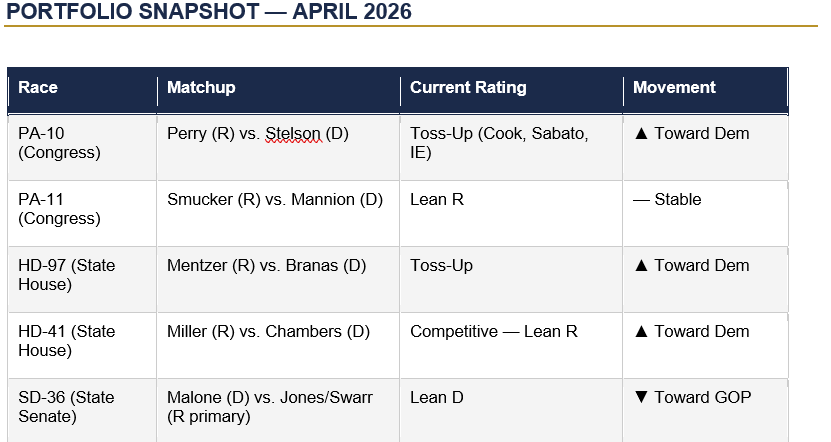
April Analyst Note
The environment has not changed direction since March. It has accelerated. Trump sits at 39 percent approval nationally and just under 40 percent in Pennsylvania — a net negative of 17 points in a state he won in 2024. The two issues that carried him here, the economy and immigration enforcement, are both moving against him. Only 28 percent of Pennsylvania voters believe the economy is improving. Fifty-six percent say his immigration enforcement is too harsh.
Four of the five races in this portfolio are in better position for Democrats than they were 90 days ago. The force driving that movement is not enthusiasm. It is anger — and anger has a specific target. Scott Perry cast the deciding vote for the largest Medicaid cuts in American history. Lloyd Smucker helped write them from the Ways and Means Committee. Brett Miller voted with the Republican caucus on every party-line vote that produced them. Steve Mentzer has no answer for any of it and has not held a public town hall since 2024.
The national signal from Texas is worth reading carefully. The Democratic Senate primary there drew record turnout — especially among Hispanic voters — powered by a candidate who showed up everywhere: Joe Rogan, Spanish-language TikTok, Stephen Colbert. Democratic operatives across the country are drawing the same conclusion: candidates who are visible everywhere outperform candidates who guard their flanks. Pennsylvania's competitive districts are not Texas. But the attention economy dynamic is identical. Voters who feel like they know a candidate vote. Voters who have only seen a mail piece do not.
The May 19 primary is the first hard test. What comes out of it — unified, funded, and moving — determines how much of this environment converts. PA-10 is the race to watch. Stelson vs. Douglas has been a managed contest so far. It needs to stay that way.
THE NATIONAL CONTEXT
House Control
Republicans currently hold 220 seats in the U.S. House. Democrats need a net gain of three seats to flip the chamber. History and current conditions both favor Democrats: the president's party has lost House seats in 18 of the last 20 midterm elections, with an average loss of roughly 25 seats. Sabato's Crystal Ball currently rates 213 seats as Safe, Likely, or Lean Democratic and 208 as Safe, Likely, or Lean Republican, with 14 Toss-Ups. Democrats are favored to win the majority — a conclusion the major forecasters have held since initial ratings were released nearly a year ago.
Pennsylvania is the single most consequential state in that calculation. Four of the most competitive seats in the country are here. Flipping PA-10, PA-7, PA-8, and PA-1 — a realistic if difficult scenario — would alone deliver the majority. No other state offers that concentration of opportunity.
Senate Control
Republicans hold 53 Senate seats. Democrats need a net gain of four to retake the majority. Of 35 seats up in 2026 — including special elections in Florida and Ohio — 23 are held by Republicans. Democrats are defending two seats in states Trump won in 2024: Georgia and Michigan. Republicans are defending one seat in a state Harris won: Maine. The Senate map is harder for Democrats than the House, requiring a near-perfect cycle to flip. The more realistic near-term target is limiting Republican expansion and positioning for a stronger 2028 map.
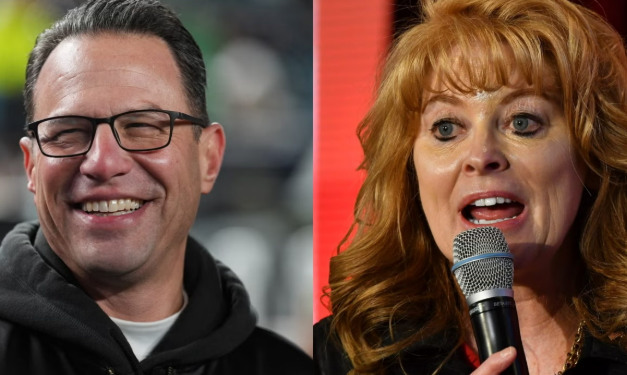
Pennsylvania Governor: Shapiro vs. Garrity
Governor Josh Shapiro is running for reelection against Republican State Treasurer Stacy Garrity. Both Cook Political Report and Sabato's Crystal Ball rate the race Likely Democratic. The February Quinnipiac poll shows Shapiro leading Garrity 55 percent to 37 percent — an 18-point margin. The March Franklin & Marshall poll shows Shapiro ahead 48 to 28. Among independents, Shapiro leads by 17 points. Two-thirds of registered voters have not yet heard enough about Garrity to form an opinion. Republicans have not won a Pennsylvania gubernatorial race since 2010.
Garrity has Trump's endorsement and has aligned herself publicly with his agenda, including the Medicaid and SNAP cuts. In a cycle where Trump is 17 points underwater in Pennsylvania, that alignment is a liability, not an asset. Shapiro's presence at the top of the ticket is the most important structural variable for every Democratic candidate in the portfolio. The wider his margin, the stronger the coattail effect in legislative and congressional races downballot.
EARLY SIGNALS: WHAT THE PRIMARIES ARE TELLING US
Texas — The Attention Economy Model
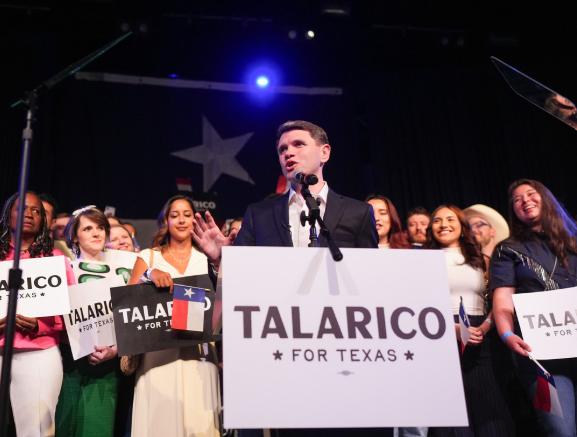
James Talarico delivering victory speech after primary victory
In the Texas Democratic Senate primary in early March, state Representative James Talarico defeated Rep. Jasmine Crockett in a race that drew 2.07 million Democratic votes — a 137 percent increase over Democratic primary turnout in 2022. Talarico's campaign ran on near-total media saturation: Joe Rogan, Spanish-language TikTok with Carlos Espina, Stephen Colbert's Late Show, and earned media in every outlet that would have him. The result was a candidate who voters felt they knew before they voted. That is the attention economy model in operation. It does not guarantee a November win in Texas — the structural map still favors Republicans. But the turnout signal is real, and the lesson is portable. Candidates who show up everywhere outperform candidates who protect their lanes.
Illinois — Volume With Caveats
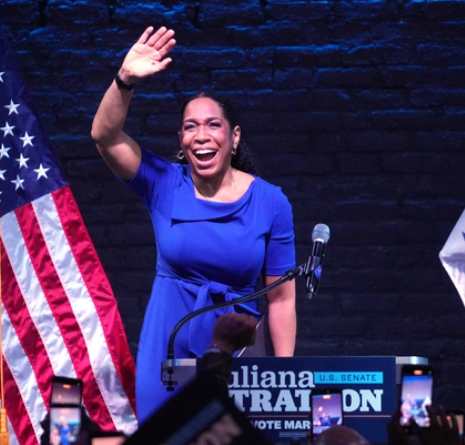
Lt. Governor Juliana Straton after primary victory
The Illinois primary on March 17 drew Democratic turnout up approximately 35 percent from the 2022 Senate primary. Lt. Governor Juliana Stratton won the Democratic Senate nomination over Reps. Raja Krishnamoorthi and Robin Kelly after a crowded, expensive primary awash in outside spending. Republican primary turnout in Illinois dropped by roughly half compared to 2022. The asymmetry — Democrats up, Republicans down — is the signal that matters. The caveat is real: Chicago turnout was up from 2022 but below 2018 levels, when Democrats gained 41 House seats nationally. Illinois is not a perfect proxy for Pennsylvania. But the enthusiasm gap between the parties, measured in actual votes cast, is running in one direction.
Florida Special Elections — The Mar-a-Lago Test
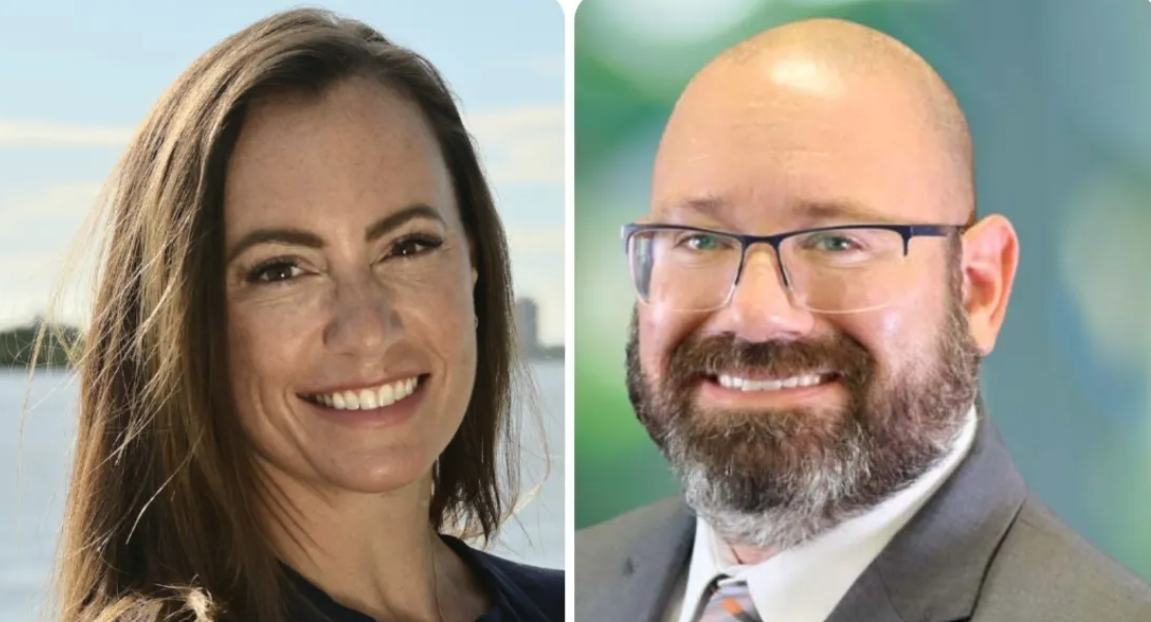
Left; Emily Gregory, Right; Brian Nathan
On March 24, Florida Democrats flipped two state legislative seats in special elections. Democrat Emily Gregory won Florida House District 87 in Palm Beach County — a district that includes Mar-a-Lago, that Trump won by more than 10 points in 2024, and that the previous Republican incumbent won by 19 points just two years ago. Gregory won by 2.4 percentage points. The same night, Democrat Brian Nathan, a Navy veteran and union organizer, flipped a Tampa-area State Senate seat that the incumbent Republican had won by 10 points in 2022. He won by 408 votes.
The Florida Democratic Legislative Campaign Committee counted these as the 28th and 29th seats Democrats have flipped from Republican control since Trump took office. Republican analysts correctly note that special elections feature atypical turnout and should not be overstated. They are also correct that the key driver was asymmetrical turnout — Democratic engagement held, Republican participation dropped in a compressed election environment. That is precisely the point. In a cycle where base enthusiasm is the primary variable, the party that turns out in special elections is rehearsing for November. Democrats are rehearsing. Republicans are not showing up to practice.
The composite signal: Texas showed what candidate-driven attention economy strategy produces. Illinois showed Democratic base enthusiasm outpacing Republicans by a measurable ratio. Florida showed that Trump's endorsement no longer guarantees performance even in his own neighborhood. None of these three data points is individually conclusive. Together, they describe the same environment: a midterm electorate moving toward Democrats in every geography where candidates are organized enough to capture it.